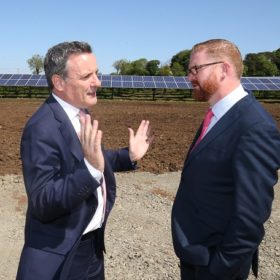
Lightsource BP acquires Ireland-based software company Ubiworx
British developer Lightsource has announced the acquisition of Irish software company Ubiworx. The company is a specialist in the internet of things and has already worked closely with Lightsource over the past two years

India may miss solar PV target, says CEO survey
The country will achieve solar PV capacity of 50 to 75 GW by 2022 – a little over 60% of the 100 GW target. Total rooftop capacity will be less than 10 GW.
Turkey introduces tax exemption for solar up to 10 kW
Although the promised new provisions for net metering are not in force yet, the Turkish government has prepared the ground for future development by granting residential projects under the upcoming scheme an exemption from the 5% income tax on excess power delivered to the grid.
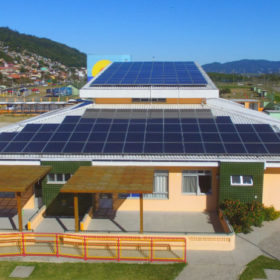
Brazil now has 250 MW of solar under net metering
According to data from Brazilian association ABSOLAR, Brazil currently has 27,803 solar PV systems connected to the grid, which benefit 32,924 consumer units and total more than BRL 1.9 billion (around $515 million) in accumulated investments since 2012.

Water-stressed countries should resort to solar, World Resources Institute says
Unlike traditional power generation, wind and solar require zero, or a mimimum amount of, water for the operations of their respective technologies. This may help most Middle Eastern and North African countries solve their chronich water supply issues, as well as several more African, Asian, American and European countries.

Oman seeks to further implement rooftop PV plan
The country’s energy regulator is now seeking proposals for the supply of a risk management system to perform operational management and risk mitigation for the Sahim 2 rooftop PV initiative.
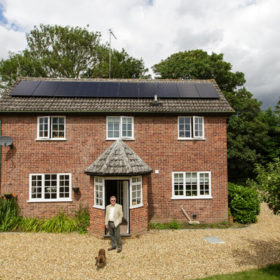
Wales to introduce energy efficiency loan benefit, applicable to residential PV installations
Welsh home buyers intending to install a roof-top PV array are set to benefit from a rejigging of loan conditions for energy efficiency dwellings.

Scotland issues EoI for energy efficiency measures including PV-plus-storage
The “Energy Efficient Scotland Transition Programme: Decarbonisation Fund for Social Housing” is aimed at helping building owners to improve the energy efficiency of homes and buildings in the commercial, public and industrial sectors.
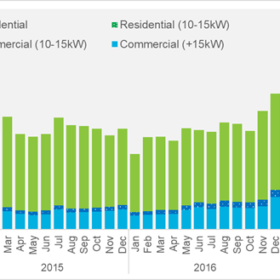
100 MW months emerge as the new normal for small-scale PV installs Down Under
Green Energy Markets’ small-scale solar figures for April reveal that above 100 MW is emerging as the new normal for monthly installations in the segment in 2018. While the month was below the record-setting 127 MW in March, April’s 109 MW indicates that installations north of 100 MW is new normal for the Australian residential and small commercial sector.

United States: California wants solar PV on all new homes
The California Energy Commission is expected to approve the 2019 Building Energy Code that calls for solar PV on all new homes. The goal is net zero residential energy usage.
