
Armenia kicks off 200 MW solar park tender
The AYG-1 project, planned in the Aragatsotn province of western Armenia, will be 85% owned by the successful developer and 15% by the Armenia Renewable Resources and Energy Efficiency Fund (Anif).

Mitigating shading in PV modules with new reconfiguration technique
Scientists in India are seeking to mitigate partial shading with a technique based on the Lo Shu nine-square grid of ancient Chinese mathematical tradition. Their approach features the ‘magic grid’ also used in popular sudoku puzzles, as a guide for reconfiguring arrays.

Italy’s second renewables auction secures lowest price of €0.056/kWh
The utility scale renewable energy tender saw wind prevail again, with 18 projects with a total generation capacity of 406 MW. Solar secured four projects with a combined capacity of 19.3 MW but did offer the lowest bid.
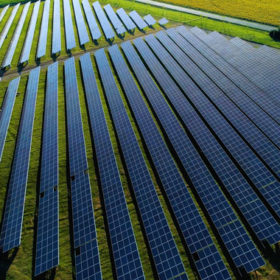
France has breached the 10 GW solar barrier
The 182 MW of new solar capacity installed in the first quarter of the year took the nation to a total 10,072 MW, according to the Ministry of Energy’s Department of Data and Statistical Studies.

Solar could hold advantage in post-pandemic global energy sector
The International Energy Agency has acknowledged dramatic falls in energy investment caused by the Covid-19 crisis but said renewables, including PV, offered an attractive proposition to investors as the dust settled, given their enticing economics and short turnaround times.
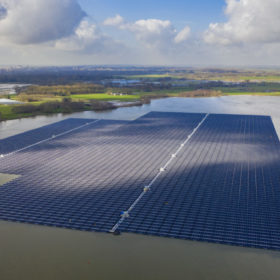
Baywa’s plans for floating PV
Over the past two years, German renewables business Baywa re has developed in-house floating solar technology and installed nearly 50 MW of projects in the Netherlands. Benoît Roux, director of solar activities at Baywa re in France, said the ramp-up in project size has enabled the company to achieve dramatic cost reductions.
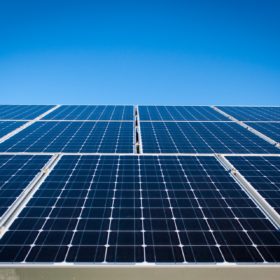
Another two merchant solar projects secure financing in Australia
Netherlands-based renewables developer Photon Energy will build two PV plants totaling 14 MW in the Riverina region of southern New South Wales (NSW). The two projects will feature bifacial PV modules mounted on single-axis trackers and will supply the produced electricity to the spot market.
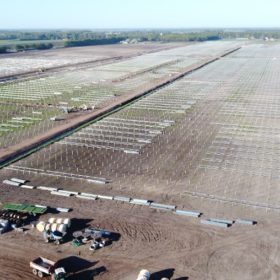
Work begins on two PV facilities totaling 146 MW in the Netherlands
Chint Solar Netherlands and Powerfield began construction of two new solar parks in the Netherlands. The Stadskanaal and Buinerveen Solar Parks follow the companies’ 103 MW Midden-Groningen Solar Park, now in operation.
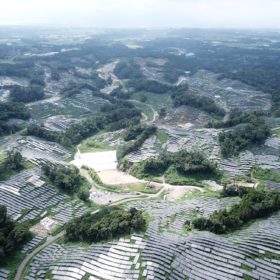
Japanese golf course becomes 100 MW solar park
A new 100 MWp solar power plant supplied with Kyocera solar modules has begun operation in Japan’s Kagoshima Prefecture. Operated by the Kyocera-backed Kanoya Osaki Solar Hills LLC joint venture, the plant is one of the largest PV facilities on the island of Kyushu. Venture partner Tokyo Century arranged financing for the project with 17 regional banks.
Chinese PV Industry Brief: 4.3 GW of new cell capacity and a 1 GW solar park
Cell manufacturer Aiko Solar is raising funds to increase its production capacity with 4.3 GW of new lines while Datang Corporation has inked a deal for a 1 GW desert project.
