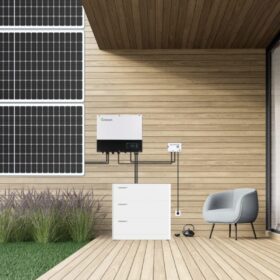
German companies launch ‘world’s largest’ plug-in PV system
Indielux and EPP Solar have released the “world’s largest” plug-in PV system, a 6 kW unit with a power storage option that connects to existing electrical setups via a safety plug. It is available in Germany, France, Austria, Poland, and Spain.

Flood precautions for rooftop PV, ground-mounted solar
pv magazine examines recommendations and precautions for flooding, as water exposure to electrical devices such as inverters or battery packs can have serious consequences.
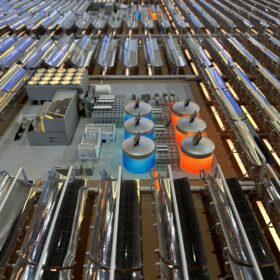
Concentrated solar power, a much cheaper solution than batteries for energy storage
By offering cheap energy storage, concentrating solar power has a huge potential. However, it requires international standards to become a competitive market proposition.

3D-printed anti-reflective cover based on aluminium oxide increases PV cell efficiency by 25%
An international team of scientists have combined cyclic-olefin copolymers with a powder of aluminum oxide to create a filament that can be used by a 3D printer to create anti-reflective covers for PV modules. The proposed innovation can reportedly improve PV cell efficiency by over 25%.

Solar brick based on perovskite, textile ceramic technology
A European research team has sought to combine for the first time perovskite solar cell technology with textile ceramic in a novel building-integrated photovoltaic device. The result is a solar brick with potential for future commercialiation, according to its creators.
Researchers build all-perovskite tandem solar cell with 28.2% efficiency
An international research team has built an all-perovskite tandem solar cell based on a wide-bandgap top perovskite cell with a 20.5% efficiency. The 1-cm2 scale tandem device achieved the highest efficiency ever reported to date for all-perovskite solar cells of this size.

Module power output distortion on rise
A study by German research institute Fraunhofer ISE has revealed a troubling trend. Data shows that modules are increasingly attributed higher power ratings than they actually have. Though the percentages are incremental, it all
adds up.
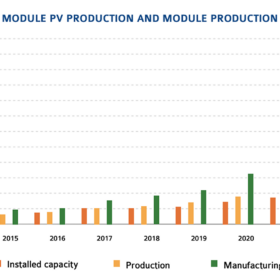
Solar manufacturing facing substantial pressures, says IEA-PVPS
The International Energy Agency (IEA) Photovoltaic Power Systems Programme (PVPS) says in its latest report that 2023 was a record-breaking but tumultuous year for solar development. It says the manufacturing industry faces pressure from supply-demand imbalances, with overcapacity causing prices to collapse.

‘There is no such thing as a global patent’
Jeffrey Saltman, partner at US intellectual property law firm Fisch Sigler LLP, recently spoke to pv magazine about the rising number of patent lawsuits between PV module manufacturers. He said this increase in litigation mainly stems from the industry’s convergence on tunnel oxide passivated contact (TOPCon) tech and noted that the number of lawsuits is likely to rise in the near future.

Controlling grid fluctuations via solar module cooling
A research group has proposed a novel method to control ramp rates in power networks. Its control optimization is based on weather, load and production forecast data. The scientists simulated the operation of the proposed technique and reached a ramp rate reduction of up to 76.2%.
