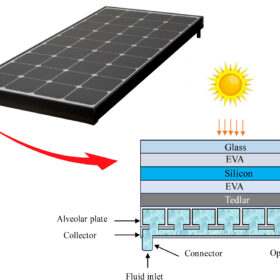
Photovoltaic-thermal panel based on channel-box heat exchanger
Scientists in Morocco have conceived a photovoltaic-thermal panel that uses a channel-box heat exchanger consisting of 94 channels attached directly to the PV module. The simulated design reportedly results in an overall panel efficiency of over 90% and good results in terms of temperature inhomogeneity.

Bee Solar, Huasun sign MoU to develop gigawatt-scale European supply chain
The Italian company and Huasun Energy are teaming up to produce wafers, cells and modules for the European market, with the aim to be the most cost-competitive in Europe. The two companies are working to start production in 2026.

Three-dimensional PV modules for indoor, urban locations
A research team at Korea Electrotechnology Research Institute (KERI) in South Korea is tackling the use of solar PV in non-ideal conditions with a new tool to optimize for urban and indoor PV diffuse light and partial shading conditions. The team also developed three-dimensional solar modules featuring a glass-free, lightweight design that features self-tracking that reportedly produces 60% more power compared to conventional flat modules.
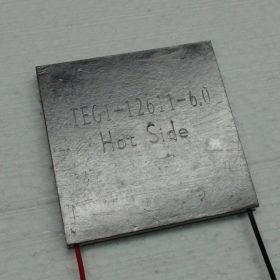
Reducing PV module temperature with water, thermoelectric coolers
Scientists in India have suggested to use thermoelectric cooling to enhance PV module performance. Through a field experiment, they found that thermoelectric coolers combined with water can reduce solar module temperature by up to 38 C.
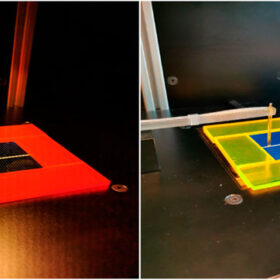
Improving solar cell performance with dye concentrators
Scientists in Poland have sought for the first time to improve PV cell yield with a new type of concentrator based on dyes. The device utilizes a tinted and luminescent acrylic glass known as polymethyl methacrylate, which reportedly increases power generation by 1.21%.
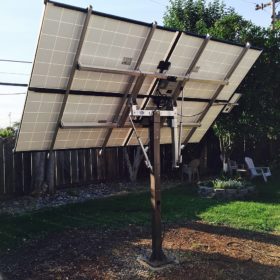
Dual-axis solar tracker based on UV, MEMS sensors
Researchers have designed a new tracking system that utilizes an arithmetic optimization-based PID controller. The proposed tracker uses two different sensor types – a UV sensor and a micro-electromechanical solar (MEMS) sensor. The first one calculates the intensity of UV radiation received from the sun, and the second one forecasts the sun’s path across the sky.

JA Solar sues rival module manufacturer over TOPCon patent infringement
The Shanghai-based solar development company has filed two complaints with the Munich and Hamburg local divisions of the Unified Patent Court.

New discovery paves the way for more efficient perovskite solar cells
Researchers from University of Texas have used computational methods to study the formation of polarons in halide perovskites. The findings revealed topological vortices in polaron quasiparticles.
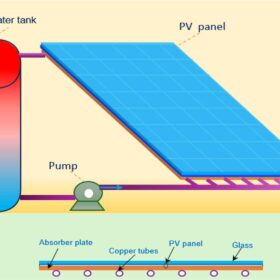
Hydronic closed-loop cooling system for photovoltaic modules
An international research team has developed a closed-loop PV cooling system that can reportedly offer 24-hour continuous operation. The system is claimed to be particularly suitable for hot and arid regions and to improve the lifespan of solar panels by up to 8.2%.
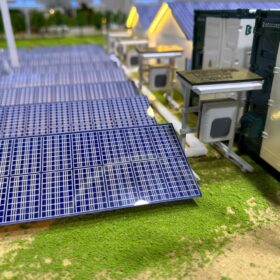
Quantum algorithm for photovoltaic maximum power point tracking
Researchers have developed a quantum particle swarm optimization algorithm for maximum power point tracking that reportedly generates 3.33% more power in higher temperature tests and 0.89% more power in partial shading tests compared to conventional swarm optimization algorithms.
