
Nigeria breaks ground on solar module assembling plant
Nigeria’s Minister for Innovation, Science and Technology has said the country is committed to replicating similar solar module assembling plants across all its geopolitical zones.

Smart buildings key to overcoming rooftop PV hurdles
In its latest monthly column for pv magazine, SolarPower Europe explains how several European countries are moving away from support schemes for injections and towards the adoption of time-variant supply tariffs, which play a crucial role in reducing daily price fluctuations. This shift challenges the traditional business case for rooftop PV, which often relies on maximizing grid injections.

Solar cell based on 2D Dion-Jacobson perovskite achieves 19.11% efficiency
Chinese researchers claim to have developed an “ultrastable” perovskite solar cell based on a two-dimensional, Dion-Jacobson phase perovskite. The device was constructed with blade coating technology and is scalable, according to its creators.
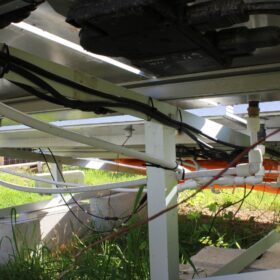
PV module cooling tech based on water chamber
Scientists in Malta have created an after-market cooling solution that can be fitted to existing standard PV modules. The system is based on a water chamber placed at the backside of the module and can reportedly provide a net electrical energy gain of more than 9%.

Tender opens for PV-driven pump irrigation projects in the Philippines
The National Irrigation Administration of the Philippines has launched a procurement project with a budget of around PHP 97 million ($1.66 million) for the development of two solar power-driven pump irrigation projects on the Loboc river.

Year-to-year solar variability peaks in Europe, Australia, Argentina, and China
In a new weekly update for pv magazine, Solcast, a DNV company, reports that the regions with the highest year-to-year variability in irradiance include Central and Northern Europe, East Coast Australia, Northern Argentina, and China, with Africa exhibiting the most stable irradiance year-on-year.
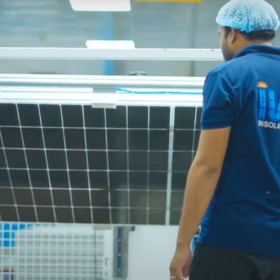
Insolation Energy to add 3 GW solar panel, 1.4 GW cell capacity by March
The Indian manufacturer is expanding its solar panel production capacity to 4 GW annually, up from a current 1 GW. It is also setting up manufacturing capacities for 12,000 MT of aluminum framing and 1.4 GW of PV cells. The new capacities will be commissioned during fiscal year 2024-25.
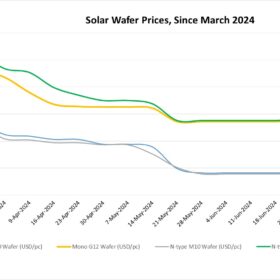
Wafer prices near bottom, size evolution and capacity globalization continue
In a new weekly update for pv magazine, OPIS, a Dow Jones company, provides a quick look at the main price trends in the global PV industry.
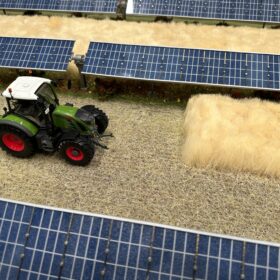
Researchers find agrivoltaics have LCOE of $0.039/kWh, 7-year payback time in India
Indian researchers have compared the performance of an agrivoltaic system to monofacial and bifacial rooftop PV systems, and have found that the agrivoltaics setup had a shorter payback time and lower levelized cost of energy. Their analysis of performance considered panel temperature, power output, land equivalent ratio, and reliability.
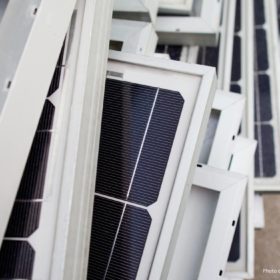
Critical mineral report highlights Australia’s solar panel recycling potential
A new report published by the CSIRO says Australia’s research into solar recycling is second in the world, outside China, but suggests the establishment of mid-stream activities such as the production of metallurgical silicon and polysilicon have big potential.
