European coalition urges EU to support PV manufacturers
A position paper from Solar Industry Regions Europe (SIRE) says a balance must be struck between protecting the European solar market and reaching the market objectives of the energy transition.
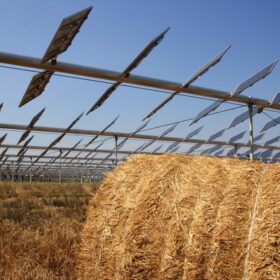
Wheat grows better in agrivoltaic facilities
New research from Italy shows lower wheat production under elevated agrivoltaic systems, but a simultaneous increase in nutritional value for livestock. pv magazine Italy spoke with the academics about their future research.
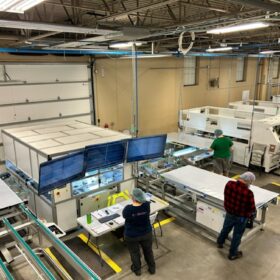
Suniva, Heliene to jointly produce US-made solar modules
Suniva has agreed to supply domestically manufactured solar cells to Heliene under a three-year sourcing contract, for integration into its solar modules.
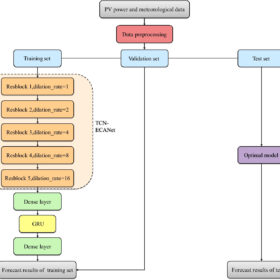
New machine learning tech for short-term PV power generation forecasting
Researchers in China have applied a machine learning technology based on temporal convolutional networks in PV power forecasting for the first time. The new model reportedly outperforms similar models during all seasons.
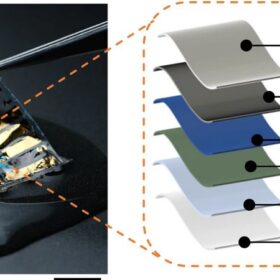
Japanese researchers develop waterproof, flexible organic solar cell with 14.3% efficiency
The organic cell retained 89% of its initial performance after being immersed in water for four hours and survived a washing machine cycle. The researchers plan to develop the technology further, with an end goal of using it for wearable devices.
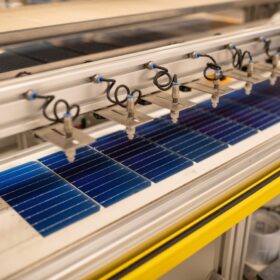
Australia announces ‘pit to panel’ solar manufacturing program
The Australian government will allocate AUD 1 billion ($652.8 million) to help build a domestic solar panel manufacturing industry to underpin the nation’s future as a renewable energy superpower.
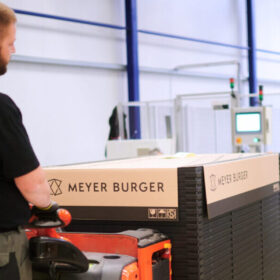
Meyer Burger announces 500 layoffs at German PV module factory
Meyer Burger says it plans to lay off 500 people at its PV module factory in Germany, but some employees might be relocated within the company. It says about 400 workers will lose their jobs.
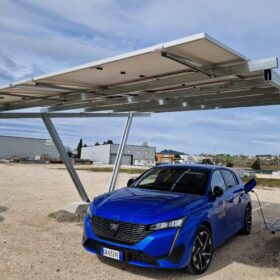
Italian municipality offers free EV recharging via off-grid PV shade
The municipality of Falconara Marittima, Italy, has installed a free off-grid photovoltaic shade for electric vehicle charging at no cost to users. The system has a capacity of 7 kW and includes a 10 kWh battery.

NREL updates online tool with data for Africa, Eastern Europe, Middle East
The US Department of Energy’s National Renewable Energy Laboratory (NREL) has added a high-resolution solar data set covering Africa, Eastern Europe and the Middle East on its Renewable Energy Data Explorer tool.

Nordcell Group plans 1.2 GW solar module factory in Sweden
Sweden-based Nordcell Group announced plans to build a 1.2 GW module factory in its home country. With a site decision coming soon, module production is planned to start in the first half of 2025.
