
Thousands of Irish schools to hit the books for solar
Up to 1,600 schools in Ireland can apply from today to receive 6 kW of solar systems to be installed on their rooftops through a federally funded scheme, the Irish government recently announced.

Photovoltaics for marine wildlife telemetry devices
A US research team has tested mini solar modules in marine data collection devices, using animal hosts for water column profile measurements. The findings suggest that submarine PV can effectively operate in these applications at depths of up to 22 meters.
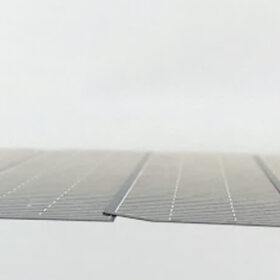
Perovskite-silicon tandem solar cells have practical efficiency potential of 39.5%
Researchers at Germany’s Fraunhofer ISE have provided guidelines for future research on perovskite-silicon tandem solar cells by identifying the most significant loss mechanisms at the perovskite/ETL interface, in the series resistance, and in light management.
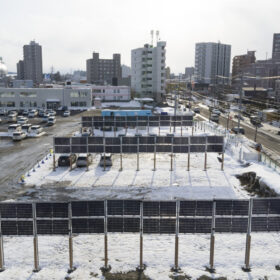
Solar irradiance modeling method for east-west oriented vertical PV
A Finnish-Norwegian research group has investigated model chains for horizontal-to-vertical solar irradiance conversion in east-west oriented vertical PV systems located at high latitudes. They have found that accuracy and bias of the model chains are different for the east and west sides of solar array.

Hanwha Qcells shuts down 3.5 GW solar factory in South Korea
Hanwha Qcells has closed its 3.5 GW solar factory in South Korea as part of plans to optimize its PV module production capabilities amid a stagnant domestic solar market.

Workflow for integration of BIPV in historical buildings
Italian researchers have outlined a four-step method to assess the technical feasibility of building-integrated PV (BIPV) projects in historical buildings. They applied the proposed approach to a courtyard building from the 16th century in the historical Italian town of Marcianise.
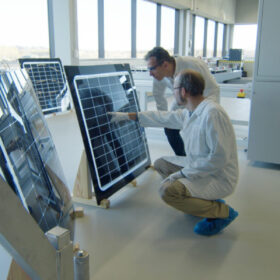
Imec integrates silicon heterojunction solar cells into curved surfaces
Imec has successfully integrated silicon heterojunction PV cells into curved surfaces, resulting in a 6% efficiency increase compared to passivated emitter and rear contact (PERC) half cells. The cells are suitable for applications in vehicle-integrated and building-integrated PV (BIPV).

Are Europe’s major solar associations divided, again?
An article published in French newspaper Le Monde recently sparked a war between two prominent European PV associations – the decades-old SolarPower Europe and the three-year-old newcomer the European Solar Manufacturing Council. pv magazine looked into the matter to unpick the potential long-term impact the rift could have on the sector.
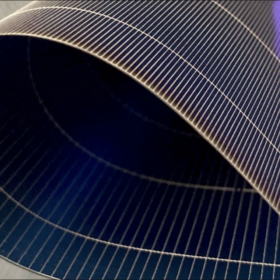
France’s INES building first TOPCon panels for space applications
France’s National Solar Energy Institute (INES) – a division of the French Alternative Energies and Atomic Energy Commission (CEA) – is developing ultra-thin TOPCon solar devices for space missions, in cooperation with the European Space Agency (ESA).
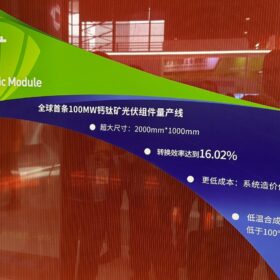
GCL claims 18.04% efficiency for perovskite solar panel
The China National Institute of Metrology has certified the result. The manufacturer claims it was able to increase the panel efficiency from 16.02% to 18.04% in a few months.
