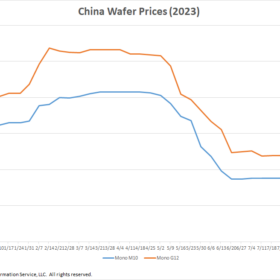
China wafer prices extend gains for third week
In a new weekly update for pv magazine, OPIS, a Dow Jones company, provides a quick look at the main price trends in the global PV industry.

Wafer formats continue to evolve
Differences in wafer and module specifications, which have bedevilled solar developers in recent years, could now be narrowing.

Italy’s Levante unveils origami solar panel with 23.4% cell efficiency
Levante is now offering foldable solar panels with the same performance of rigid panels. The portable modules are available in 330 W and 500 W versions.

US solar market reshores energy supply chain following passage of IRA
The US solar market has started to reshore its energy supply chain, just one year after the passage of the US Inflation Reduction Act (IRA).
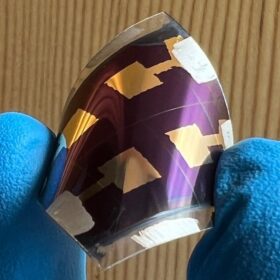
Flexible indoor perovskite solar cell achieves 32.5% efficiency
Italian scientists have developed a flexible indoor perovskite solar cell with 32.5% efficiency. Their design uses a PET substrate combined with a tetrabutylammonium bromide layer over the perovskite absorber. This additional layer effectively reduces defect density and enhances the stability of the underlying 3D perovskite structure.
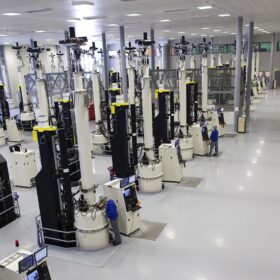
NorSun secures $8.5 million in recent funding round
Norway’s NorSun, a monocrystalline silicon wafer supplier and ingot manufacturer, has raised NOK 90 million ($8.5 million) to support its projects.
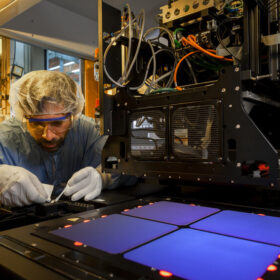
Novel approach to identify silver shortages in PV industry
A Dutch-German research team has used a unique method to detect silver shortages in the PV industry. By mapping the silver supply chain from 1995 to 2021, they have identified distinct supply patterns and associated risks.
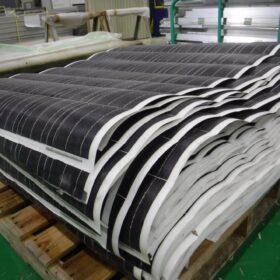
Advancing circular economy in photovoltaics: The Hot Knife PV module recycling method
Recycling is of significant importance in a circular economy, yet some challenges have to be faced when recycling PV modules. The novel Hot Knife method to separate the crystalline silicon photovoltaic module front glass from the backsheet contributes only a few permill to the life cycle related potential environmental impacts of PV electricity.

Chinese PV Industry Brief: JinkoSolar reports strong H1 earnings
JinkoSolar has reported a net profit of CNY 3.8 billion ($526.6 million) for the first half of 2023, while Maxeon has revealed plans to open a 3 GW TopCON cell and module factory in the United States.
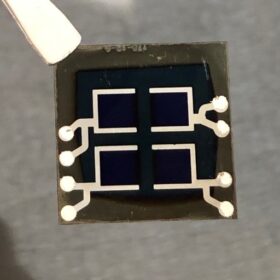
Two-terminal perovskite silicon tandem solar cell with 25.6% efficiency
The Fraunhofer ISE has developed an electro-optically optimized transparent conductive oxide layer that can reportedly improve the efficiency of perovskite-silicon tandem solar cells. A device built with the film achieved remarkable efficiency and fill factor.
