
Summit Ridge Energy procures 1.2 GW of US-made Qcells panels
Summit Ridge Energy’s latest order marks the largest domestic community solar purchase of PV modules in US history. It includes 20 MWh of Qcells Geli energy storage systems.

Grew Energy wins 2 GW of wafer-to-module capacity in India
India’s Grew Energy will secure $69.3 million of incentives for 2 GW of integrated wafer-cell-module production.

Taiwanese scientists develop high-concentration PV system
Taiwanese researchers have developed a system featuring a 2 × 2 Fresnel lens array and a solar panel made of III-V materials and polycrystalline solar cells, with low light leakage.

Bigger modules, bigger headaches?
The debate continues over whether super-sized, high-power solar modules are a good thing for the industry and they appear to be here to stay. Vicente Parra and James Whittemore, from Enertis Applus+, consider the pitfalls to avoid when designing high-power solar projects.
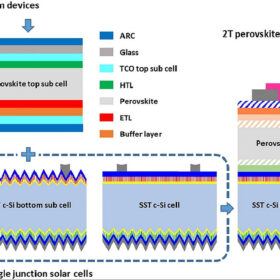
Poly-SiOx solar cell for 4T, 2T perovskite-silicon tandem devices
Scientists in the Netherlands have developed a new crystalline solar cell based on poly-SiOx passivating contacts. The poly-SiOx tech results in a 20% efficiency rating, but 4T tandem perovskite-silicon solar cells based on the poly-SiOx cell can reach an efficiency of 28.1%, and 2T tandem perovskite-silicon devices can hit 23.2%.
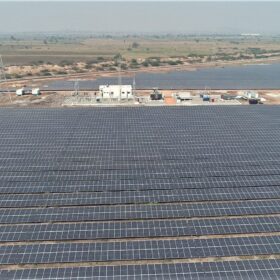
Amp Energy India secures 1 GW of solar cell, module capacity under PLI scheme
Amp Energy India has won $17 million of incentives to set up 1 GW of integrated solar PV cell and module production capacity.

India’s Jakson buys 600 MW PV module production line from Jinchen
Jakson says its new, fully automated manufacturing line will produce the latest p-type, n-type, and G-12 solar modules, in both mono-facial and bifacial formats.

Dutch heating specialist offers solar-tied thermal battery for domestic hot water
Netherlands-based One Solution says its new FlexTherm Eco battery can be used in combination with rooftop PV systems and residential photovoltaic-thermal installations. It consists of a thermal charging station that converts power directly into heat and stores it for the provision of hot water.
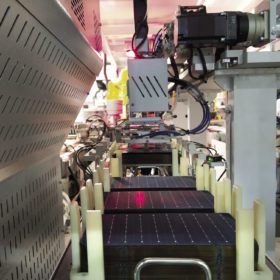
India’s solar module manufacturing capacity could hit 110 GW by 2026
India could become the world’s second-largest solar manufacturer by 2026. It will also have a notable presence in all upstream components of PV production, such as cells, ingots/wafers, and polysilicon, according to a new report.

Imec unveils 781 cm2 bifacial perovskite solar panel with 11.9% efficiency
Scientists in Belgium have developed perovskite solar panels with a thermally stable device stack. The encapsulated bifacial panels they created with this configuration were able to retain around 92% of their initial efficiency after 1,000 hours.
