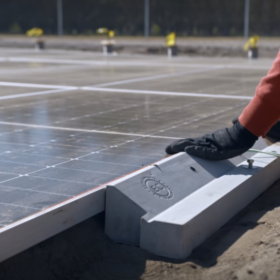
US startup to build 100 MW solar plant with modules on ground
Erthos claims that with its new installation method, solar facilities could occupy just one-third of the surface covered by conventional PV plants, potentially reducing installations costs by up to 20%.
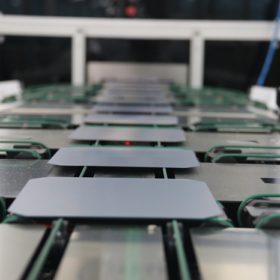
Chinese PV Industry Brief: Longi, TCL cut wafer prices by more than 20%
Longi and TCL Zhonghuan have announced wafer price cuts, Arctech Solar said it will supply 2.8 GW of single-axis trackers for solar projects in India, and Risen Energy has started mass production of its heterojunction (HJT) solar modules.
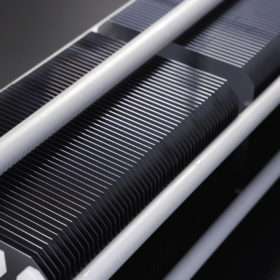
European solar manufacturers need state aid exemptions – now
If Europe is to come up with its own Inflation Reduction Act moment, and incentivize a return of EU solar manufacturing leadership, it must lift state-aid related restrictions on the PV manufacturers who have announced a willingness to build 30 GW of production lines.
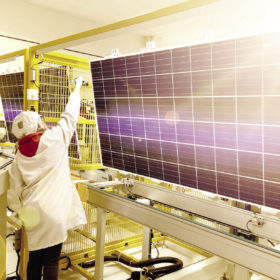
2022 review in trends: Modules (Part II)
N-type technology’s shift to the mainstream of PV production was a major development in solar cell and module manufacturing in 2022. Manufacturers added TOPCon and HJT capacity and racked up efficiency milestones in the process.
2022 review in trends: Modules (Part I)
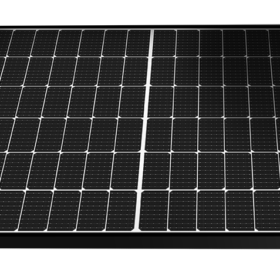
The move to n-type technology in mainstream PV production was a major development in PV cell and module manufacturing in 2022. Manufacturers added TOPCon and HJT capacity and racked up efficiency milestones in the process.
Weekend read: Navigating hailstorms
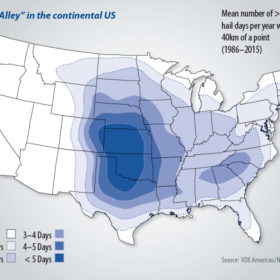
Owners and insurers suffered record hail losses in 2022. John Sedgwick, president of engineering advisory VDE Americas, provides some pro tips for mitigating such risks.
Chinese PV Industry Brief: Trina to supply 875 MW of trackers for Qatar solar plants
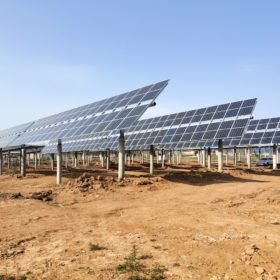
Trina Solar has signed an 875 MW tracker supply deal with Samsung C&T for Qatar’s new “IC Solar” project, while Chint said it aims to sell up to 8 GW of residential PV assets by the end of 2023.
Sunbond unveils 550 W mono PERC modules
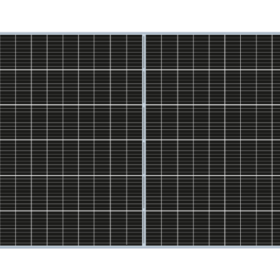
India’s Sunbond Energy has developed new mono PERC modules built with 144 half-cut M10 cells and 10 busbars. They are available in power outputs ranging from 520 W to 550 W, with efficiencies of 19.83% and 21.23%.
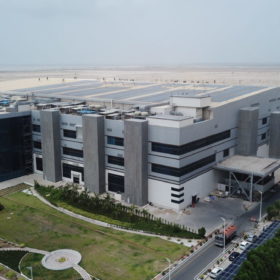
Adani becomes India’s sole producer of large monocrystalline silicon ingots
Adani Solar has started producing large monocrystalline silicon ingots for M10 and G12 wafers. It is targeting 2 GW of ingot and wafer capacity by the end of 2023 and 10 GW by 2025.

New process increases efficiency of CIGS bifacial thin-film solar cells
Researchers from the Swiss Federal Laboratories for Materials Science and Technology (Empa) have developed a new low-temperature production process for bifacial thin-film solar cells based on copper indium gallium diselenide (CIGS). It resulted in record yields of 19.8% for front lighting and 10.9% for rear lighting.
