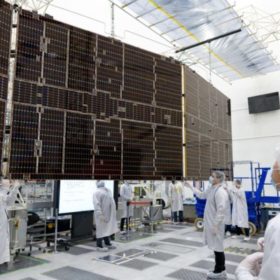
Solar panels power the largest optical telescope in space
Our deepest view into the universe is powered by PV. NASA was one of the earliest adopters of solar technology, and it continues to be an important feature of spacecraft today.
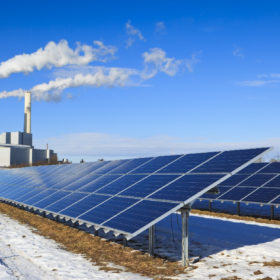
Solar power costs continued to fall in 2021, despite rising panel prices
The average global price of solar kilowatt-hours fell 13% on 2020’s prices, as around two-thirds of the renewables capacity installed last year was cheaper than the lowest-cost fossil fuel alternative.
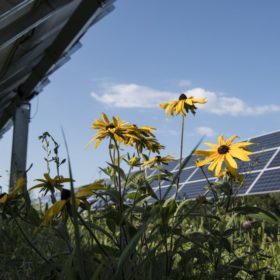
Novel method to turn existing solar parks into agrivoltaic facilities
An international research team has developed a new methodology to increase levels of pollination at ground-mounted solar plants. It involves the development of new vegetated land cover below and around solar parks.
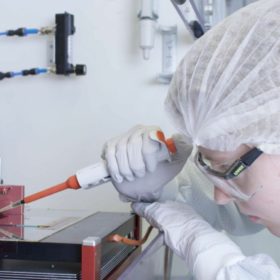
Eco-friendly solvent for a 16.7% perovskite solar cell
Scientists in Germany looked to eliminate the use of toxic solvents in the production of perovskite solar cells, replacing them with a more environmentally material called dimethyl sulfoxide (DMSO) which has so far proved difficult to integrate into processes suitable for large-scale production. The group demonstrated a scalable blade coating process using DMSO as the only solvent, and reached cell efficiencies close to those achieved using more toxic substances.
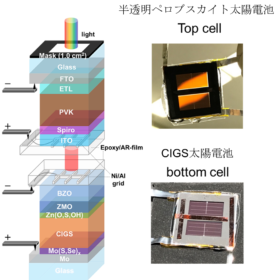
Four-terminal tandem perovskite/CIGS solar cell with 26.2% efficiency
Japanese scientists have developed a tandem device with a 19.5%-efficient perovskite top cell. They claim to have created a semi-transparent perovskite solar cell while maintaining high performance.
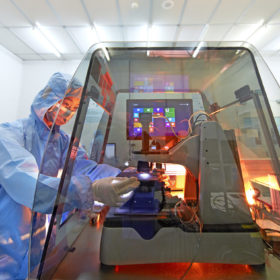
Trina Solar achieves 24.5% efficiency for 210 mm p-type PERC solar cell
Trina Solar said the State Key Laboratory of PV Science and Technology in China has confirmed the efficiency rating of its latest solar panel.

REC Group secures EU funding for HJT solar factory in France
REC Solar has announced plans for a PV module gigafactory in France, along with 17 other clean tech projects that will share €1.8 billion ($1.8 billion) of grants from the European Union’s Innovation Fund.

pv magazine Roundtables: Videos on solar everywhere, PV manufacturing trends, risk sharing in PPA markets, and green hydrogen
On day two of the pv magazine Roundtables Europe event, we focused on minimizing land competition for PV with dual use applications, how high efficiency n-type cells are progressing toward large-scale manufacturing at competitive cost, PV module design choices, how unsubsidized power purchase agreements can adapt and evolve, and the determining conditions for solar-plus-storage and solar-plus-hydrogen business models, among other key PV issues. The last five sessions are now available to view on demand.
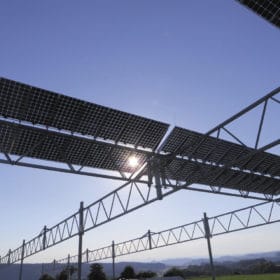
New method to evaluate performance, LCOE of elevated agrivoltaics
Scientists in Belgium have developed a way to assess elevated agrivoltaic projects, by calculating key performance indicators such as energy yield and levelized cost of energy (LCOE). They have found that shade-tolerant crops such as potatoes could potentially be paired with around 1,290 GW of PV capacity in Europe.
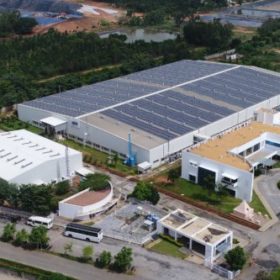
India’s Emmvee eyes wafer-to-module production
India’s Emmvee Photovoltaic has a 1.25 GW module manufacturing facility that can produce polycrystalline and mono PERC solar panels, with the ability to upgrade to TOPCon. By the end of 2023, it plans to raise its PV module capacity to 3 GW.
