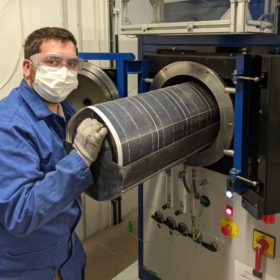
New PV module recycling tech from France
French start-up Rosi Solar has developed an industrial solution claimed to be capable of recovering high purity silicon, silver and copper contained in end-of-life PV modules. The company’s technology is based on a pyrolysis process that makes it possible to isolate the different metals from the cells.
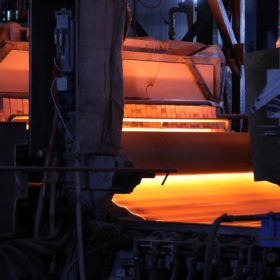
India’s Borosil to expand solar glass production capacity to 2,000 tons per day
The solar panel glass manufacturer expects strong growth in demand for its products at home and abroad with a significant rise expected in the production of PV modules in the USA and Europe.

High reliability 600W+ PV modules point the solar industry in a new direction
Trina Solar, the pioneer of 210mm large format high power PV modules, speaks to pv magazine about its strategy for their deployment. Dr. Zhang Yingbin, Trina Solar’s head of product strategy and marketing, discusses the business solutions Trina provided for its new products, while Todd Li, President of Trina Solar Asia Pacific, shares his views on the PV markets in the Asia-Pacific region.
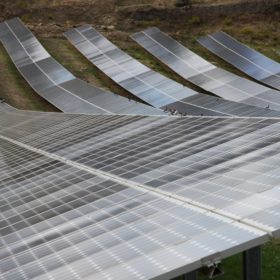
New poly fabs could head off first-half solar project slowdown
Norwegian analyst Rystad Energy has warned the solar industry could suffer the same effects of rising input prices as onshore wind developers grappling with ever more costly steel, with much hinging on how much solar panel raw material polysilicon can be manufactured.

Multi-junction solar cell integrating radiative cooler
The triple-junction solar cell is based on indium gallium phosphide (InGaP), gallium arsenide (GaAs), and Germanium (Ge) and is made with a micro-grating made of glass, consisting of a two-dimensional x-framework structure fixed onto the surface of the solar cell. Its operating temperature was found to be 6 degrees Celsius lower than that of a reference cell without the cooling technique.

Photovoltaics for multistage flash desalinators
Scientists have investigated how utility-scale solar may be used to power multistage flashing-brine recirculation (MSF-BR) water desalination plants in Aqaba, Jordan. They found the facility would be sufficient to provide the entire city with drinking water. The proposed system configuration comprises a 30 MW solar plant and a standar MSF-BR unit.

Chinese PV Industry Brief: GCL-Poly wants to move to Shanghai Stock Exchange
In other news, Longi raised funds to build another 18 GW of solar cell capacity and Suntech began work on its 10 GW module factory in Anhui Province.
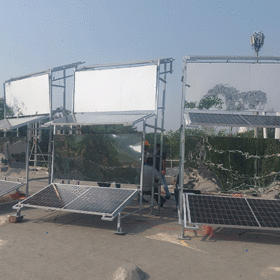
Portable, space-saving photovoltaic towers
Researchers at the Indian Institute of Technology Delhi have developed solar towers that can be moved from one place to another and can generate 20-30% more power while requiring only 50-60% space compared to conventional mounting setups.

Subwavelength antireflective structure for thin-film solar cells
Consisting of a two-dimensional (2D) array of rings and pillars, the structure can improve the short-circuit current of a thin-film crystalline solar cell by over 50%, its creators say. The subwavelength AR structures are robust to certain degrees of fabrication errors, they add.
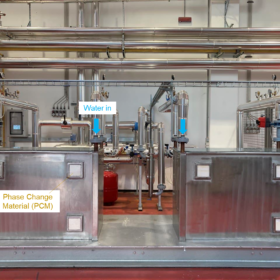
Latent heat thermal storage with PV for nearly zero-energy buildings
Researchers in Italy are combining PV with latent heat thermal storage (LHTM) and other renewable energy sources to maximize clean energy consumption in buildings. The 47kW PV array and LHTM system work independently, but the scientists said that a heat pump could be used to link them.
