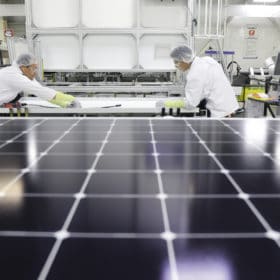
Maxeon extends IBC modules’ product, perfomance warranty to 40 years
The manufacturer said the 40/40 warranty is the longest and most comprehensive combined warranty offered in the photovoltaic industry to date. The product line is sold in most countries outside the United States and Canada under the SunPower Maxeon brand.
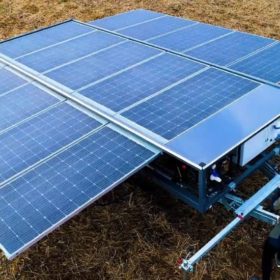
Solar trailer for off-grid applications from France
Developed by French start-up Ecosun, the trailer is equipped with 15 solar panels with output of 360 W and batteries with a storage capacity of 23 kWh. It can be used for construction sites, military camps and water pumping systems.

Solar for churches
Churches use energy mostly during the day, which makes them ideal buildings to deploy solar panels. Scientists in the United Kingdom have assessed the financial viability of a rooftop PV project for Bath Abbey and found that it could become profitable after 13 years.
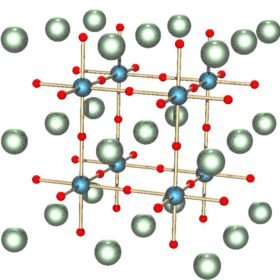
Perovskite solar cell with 24.18% efficiency via low-dimensional perovskitoids
Chinese scientists used perovskitoids as 1D and 0D capping layer materials for the cell’s perovskite layer. These materials enabled an effective and all-around passivation of the perovskite surfaces and grain boundaries, which prevents undesired Shockley-Read-Hall recombination and material degradation. The device achieved a power conversion efficiency of 24.18%, an open-circuit voltage of 1.151 V, a short-circuit current of 25.96 mA/cm2, and fill factor of 80.91%.
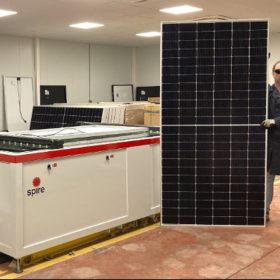
Solar simulator for high-power photovoltaic modules
Spire Solar Iberia has developed a state-of-the-art XL solar simulator that is able to measure the maximum power of photovoltaic modules of any size with high precision and to identify those with low performance.
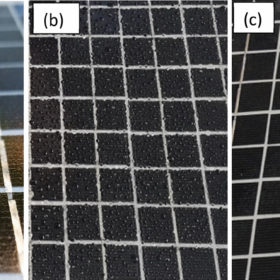
Titanium wires-based anti-soiling coating to improve solar module yield
Researchers in Thailand have developed an anti-reflective and anti-soiling coating for commercial solar modules that is claimed to increase power yield by over 6%. The coating has photocatalytic properties that make the organic compounds adsorbed on the solar module surface decompose, thus preparing them to be easily washed off by rainwater.
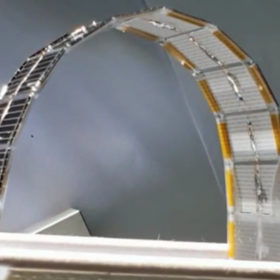
Sun-tracking tessellated photovoltaic array for use in space-restricted areas
Created by scientists in Korea, the shape-transformable 3D PV system is claimed to be able to increase electricity yield by 60% over a day compared to a fixed flat panel due to the shorter shadow length and the bifacial effect obtained during shape transformation. The proposed system doesn’t need any machinery to follow the sun and its developers said it would be a perfect solution for both urban and rural environments with limited space.
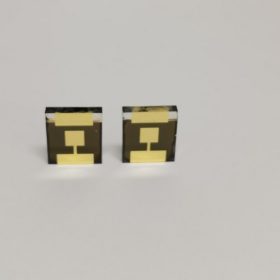
Perovskite solar cell with record-breaking fill factor of 86.6%
An international group of researchers has achieved the highest fill factor reported for perovskite cells of any size to date. The device was fabricated with a nitrogen-doped titanium oxide (TiOxNy) electron transport layer aimed at improving charge transport between the cell’s perovskite absorber and the electrodes.
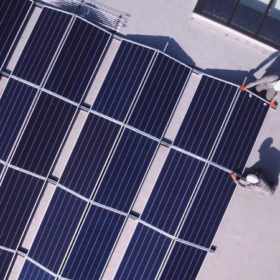
Maxeon to offer IBC solar panels in the US
The company announced an expanded commercial and industrial push in the states and a partnership with protection and performance plan provider Omnidian. Maxeon said it will offer its interdigitated back contact (IBC) panels in the US.
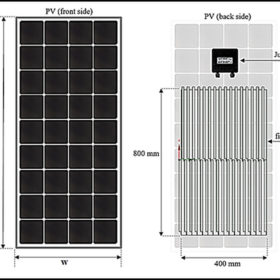
Multi-level fin heat sinks for solar module cooling
Developed by Malaysian scientists, the proposed multi-level aluminum fin heat sinks (MLFHS) were found able to reduce the module operating temperature by up to 8.45 degrees Celsius and increase power yield by up to 10.75%. The system cost was estimated at $0.60/W.
