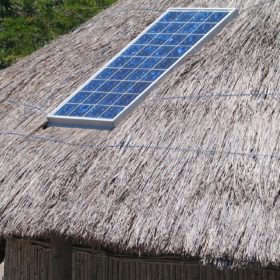
Solar manufacturers warn of 12-18 months disruption for standalone products
Potential price rises of 14% for the solar home systems that are driving access to electricity in the world’s under-served regions could signal further arrested progress towards the UN goal of universal access by 2030.
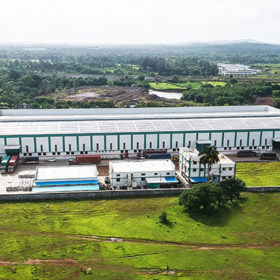
Waaree completes supply of 300+ MW solar modules for American project
The Indian-based PV module maker supplied mono PERC solar PV modules for a 250 MW project stage for a large Californian project, the 2.7GW Westlands Solar Park, located south of Fresno in California.
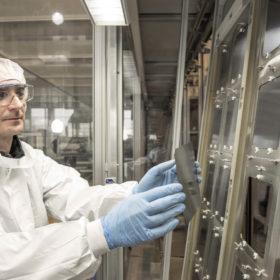
The implications of a messy Meyer Burger-Oxford PV divorce for European perovskites
Last week’s announcement Oxford PV wants to wind up its “exclusive cooperation” with Meyer Burger after the fit out of its 100 MW German factory points to a potential divergence in strategies. And with Meyer Burger considering legal action in response, it could result in a messy, disruptive separation.
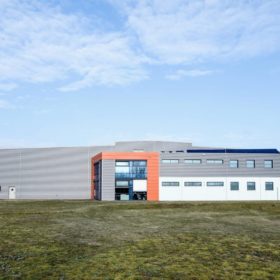
Meyer Burger considers legal action as Oxford PV unilaterally terminates exclusive cooperation
Meyer Burger claims machines to produce perovskite tandem solar cells are still missing at Oxford PV’s manufacturing plant in Germany’s Brandenburg an der Havel. Despite this, Oxford PV terminated the cooperation with the turnkey machine supplier in a surprise move last week. The Swiss technology group, which now produces its own heterojunction solar cells and modules in Germany, is now considering legal action.
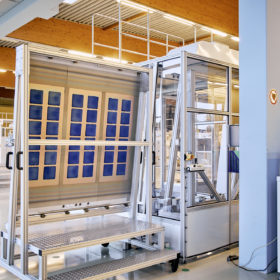
Oxford PV completes 100 MW factory build out
Perovskite tandem developer Oxford PV has completed the fit out of its 100 MW tandem cell line in Brandenburg, Germany – although the company awaits for the delivery of one perovskite deposition tool, which would complete the high efficiency cell process. Oxford PV, which in December 2020 hit a new world record cell efficiency of 29.52%, hopes to begin commercial production in early 2022.

Chinese PV Industry Brief: Slightly lower polysilicon prices and another 20 GW of PV wafer capacity
According to the China Nonferrous Metals Association, polysilicon prices declined by around 1.4% last week. In other news, Gaoce announced another 20 GW PV wafer factory and Hareon Solar filed for bankruptcy.

Organic solar panels designed with coloured Moiré effect
French organic PV specialist Armor, and a Dutch designer specialized in integrating PV in furniture, windows and other objects, have provided the module technology for the Netherlands’ pavilion at Expo 2020 Dubai.

‘Polysilicon shortage will continue through 2021’
The latest global PV industry outlook published by trade group SolarPower Europe, has indicated tight supply of the solar panel raw material is expected to persist this year but the trade body said it would be unlikely to drive further price rises.
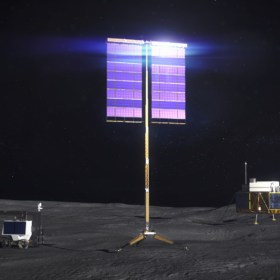
NASA developing 10 kW movable PV array for moon mission
NASA plans to place a solar array on a tall mast to avoid lunar shading and capture uninterrupted light. It will hang a pair of PV cell blankets from a horizontal cross arm supported by the mast, anchored to a deployable tripod base.
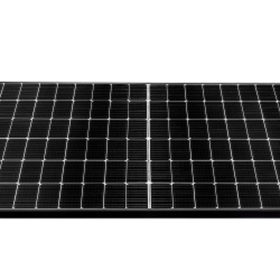
REC unveils second generation of its N-Peak solar module
The manufacturer plans to start production of the performance-enhanced solar modules in August. The first customers should then receive the products in October.
