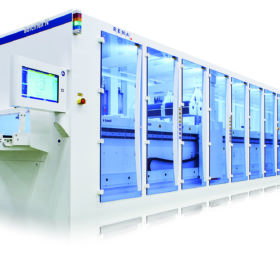
RENA picks up 15 GW equipment order
Germany based PV equipment supplier RENA Technologies has received what it describes as its ‘biggest ever order’, from a tier 1 manufacturer in Asia, for 15 GW of its wafer texturing equipment. Financial details of the deal have not been disclosed, although the company states that the order is worth “tens of millions of euros.”
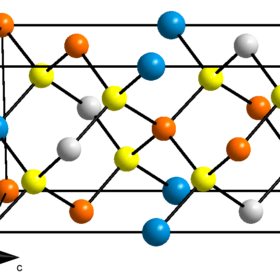
Defect analysis promises kesterite solar cells with 18.47% efficiency
An international research group has found that the presence of a few lattice defects in a kesterite PV cell material can actually improve efficiency, rather than lowering it. The group believes that kesterite PV cells could see mass production within the next decade.
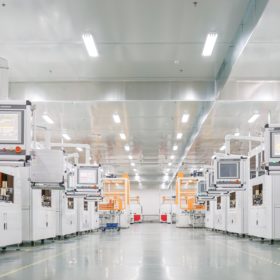
SNEC 2020 CEO Series: Suntech bounces back
Once an industrial solar giant, Suntech has worked hard to rebuild its foundations and regain a solid footing in the global PV industry, following its financial crash in 2013. pv magazine caught up with CEO Tang Jun at this year’s SNEC 2020, held in Shanghai, China, last month, to find out its plans for the future, and how the Covid-19 pandemic has affected operations. Strong global growth and continued multi-crystalline production are two cornerstones of the business.
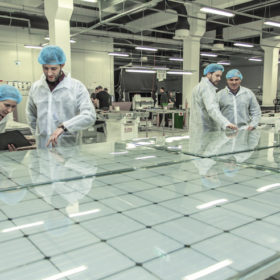
The weekend read: Materials in the circular economy
A number of companies are now racing to find new materials to replace toxic or otherwise unsafe elements in PV modules, in pursuit of circular economic ideals. In a similar vein, many researchers are also looking for ways to recycle and reuse some of these materials at the end of solar panel lifetimes. In line with these efforts, artificial intelligence and machine learning now play a critical role in identifying new chemical footprints for PV modules and cells.
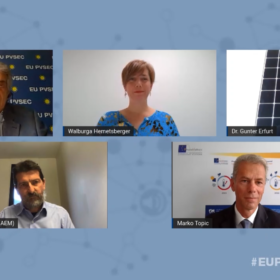
EU PVSEC 2020: Five takeaways
Spread across this week, the 37th EU PVSEC conference brought together companies and research institutes from Europe and further afield. This year’s presentations point to an industry standing at a crossroads. New challenges lie ahead, but there is plenty of optimism surrounding continuing growth and a more central role for PV in energy systems over the next decade. As the conference drew to a close on Friday, pv magazine offers five key takeaways.
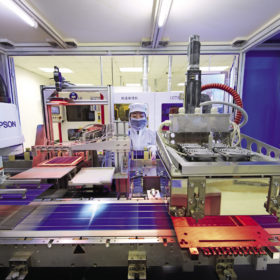
Chinese PV Industry Brief: Trina acquires Enclave, Sungrow secures EPC contracts for 300 MW
Module manufacturer Trina Solar has completed the acquisition of the Spanish tracker company, inverter maker Sungrow has secured contracts from Three Gorges New Energy and Akcome Technologies has completed construction of its heterojunction cell and module factory.

Local content requirement costs for large-scale PV in India
A UK-German research team analyzed solar auctions in India between 2014 and 2017 and has determined that local content requirements have driven up PV costs by an average of 6% per kilowatt-hour.
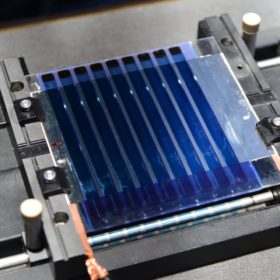
More efficient large-area organic solar cells with spin coating
Researchers in South Korea have used the process to increase performance and the replicability of large-area organic cells. The method was used during film formation to speed up solvent evaporation.
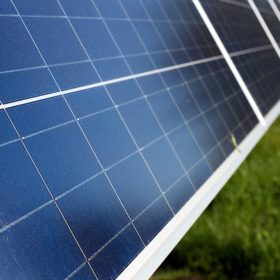
Titanium oxide nanofluid-based cooling technique for PV panels
Indian and Malaysian scientists have developed a new cooling system featuring an assembled back-channel attached on the rear sides of solar panels, to channel flows of titanium oxide and water. They used a 0.6% nanofluid concentration – the optimum value of nanoparticle concentration in water.

First Solar brings modules to distributed generation market
The U.S. utility-scale PV pioneer is going small. After decades of avoiding distributed generation, it is now offering its Series 6 modules for ‘projects and customers of all shapes and sizes.’
