
Perovskite solar cell testing in underwater environments shows surprising efficiency results
Researchers in Italy have tested how perovskite solar cells could perform underwater and have found that, at very shallow depths, they may even achieve a higher power conversion efficiencies compared to reference devices operating under out-of-water conditions.

SolarStations.org: Mapping the future of solar resource assessment
IEA PVPS Task 16 recently introduced SolarStations.org, a global catalogue of solar irradiance monitoring stations designed for researchers, developers, and policymakers. This openly available resource catalogues more than 800 multi-component stations –of which more than 400 are currently active – offering a comprehensive view of high-quality ground-based solar data.

WorldOne Energies to set up 1 GW solar module factory in Canada
WorldOne Energies has announced plans to build a 1 GW solar module factory in Ontario, Canada, marking a major step in its global expansion beyond India. The facility will produce tunnel oxide passivated contact (TOPCon) bifacial modules and cater to the North American market.
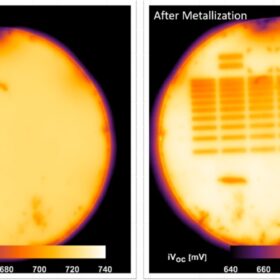
Swiss researchers seek to simplify TOPCon cell production with single-step annealing process
A Swiss research team has developed a novel single-step annealing process for tunnel oxide passivating contact (TOPCon) solar cells. Demonstrating the approach, the scientists built a proof-of-concept TOPCon device with a 21% efficiency.

Chinese PV Industry Brief: Kaisheng New Energy plans new solar glass factory
Kaisheng New Energy says it plans to build a 2,000-ton-per-day photovoltaic glass plant in Zigong, Sichuan province.
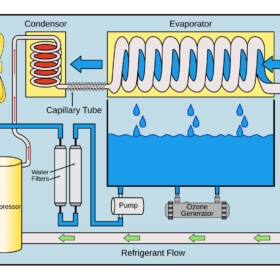
Photovoltaics for atmospheric water harvesting
A scientist in Turkey has simulated eight PV-supported hybrid atmospheric water harvesting systems and compared their performances. They were all considered to operate with R1233zd(E), R1234yf, and R600a, as well as R32 refrigerants. The required PV system size was as low as 20 m2.

Tongwei achieves 91.7% bifaciality factor for 722 W TOPCon solar module
The Chinese manufacturer said the result was confirmed by TÜV Rheinland. It was achieved through a sunken pyramid structure that reportedly achieves selective-texture on the non-electrode area of rear-side and a zebra-crossing passivation contact structure that is said to ensure excellent passivation.

U.S. startup offers tin oxide, nickel oxide materials for flexible perovskite solar cells, modules
Sofab Inks, a spinoff of University of Louisville in the United States, says its transport layer materials enable perovskite solar cells with greater stability, efficiency, and scalability compared to incumbent materials.
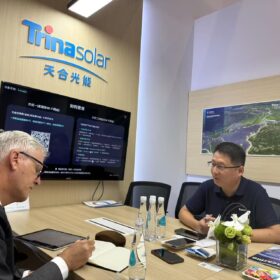
Trinasolar targeting ‘high-value’ markets
Yang Bao, Trinasolar’s president of global sales and marketing, recently spoke with pv magazine about the company’s strategy for the solar and energy storage business.

Photovoltaics for agromining
Researchers in France have investigated how photovoltaic power generation can be combined with the growth of hyperaccumulating plants in disused, contaminated brownfield land and have found this combination could help increase the profitability of the so-called agromining – a plant-based approach to cleaning up contaminated environments.
