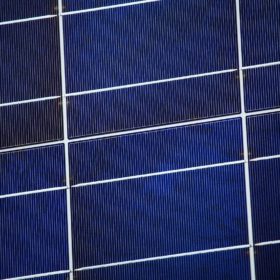
Assessing impact of residual stress in solar cells
Scientists in China have analyzed the impact of residual stress in triple-junction solar cells used in aircraft and satellite applications. The group observed damages such as holes, fractures of grid lines, cracks at the cell level, and fractures of the PV materials.

A gigawatt solar factory in Europe? Why it must be in France
With Swiss solar equipment company Meyer Burger laying plans for a module fab in North Rhine-Westphalia and Norwegian panel maker REC Group mulling a fab in Sarreguemines, northeastern France, Xavier Daval – from French renewables association the SER – says it is time Europe resumes its path to a stable solar manufacturing industry, not least because of the rising proportion of solar module costs accounted for by shipping.
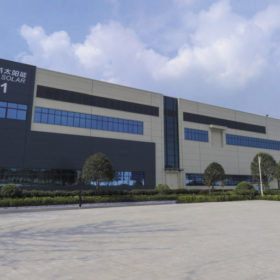
Chinese PV Industry Brief: Lower wafer prices, new modules, and a factory under construction
Longi has announced more cuts to wafer prices, while cell manufacturer Tongwei has started building the first phase of its 30 GW Jintang PV manufacturing base. Risen Energy has also released solid financials, while JA Solar has unveiled plans to start selling its 500 W-plus solar modules.
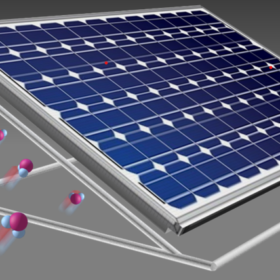
Harvesting atmospheric water to cool down PV panels
Scientists from Saudi Arabia have proposed a new PV panel cooling technique which employs an atmospheric water harvester. The device uses waste heat from the PV panel to collect atmospheric water at night and then releases it during the day to cool down the module. The researchers claim the device may also be improved to produce liquid water, which could be used for the cleaning of the modules.

500 W-plus panel race intensifies with JA Solar’s new module, Risen’s first shipments
Chinese manufacturer JA Solar has announced a new 525 W+ panel and said the product will be available from the second half. Domestic rival Risen has shipped the first batch of its high-powered modules and intends to stick to pre-Covid-19 plans to ramp up production.

Investigating backsheets and ultraviolet stability
Five testing laboratories led by Germany’s Fraunhofer ISE have begun a ‘round robin’ project to test the effects of ultraviolet light on polymer backsheet materials. Initial results indicate a route to accurate accelerated testing of backsheet UV stability over module lifetimes of 20 years-plus.

Solar canopies can put PV panels in some new and interesting places
A major advantage of this design is the ability to string cables over a longer distance without the support needed in traditional racking approaches.
Chinese PV Industry Brief: New capacity expansion plans and 100 MW of PV for a poverty-alleviation project
Three major Chinese PV manufacturers have announced capacity expansion plans over the past week. Chint also released its 2019 financial results, while Kstar unveiled a new inverter supply deal.
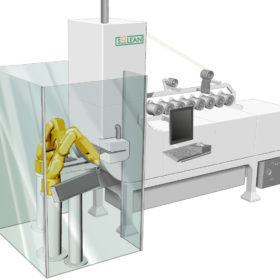
French solar equipment supplier touts fully automated production line
Startup Solean claims that its new fully automated production equipment offers a highly flexible way to bring panel manufacturing back to Europe.
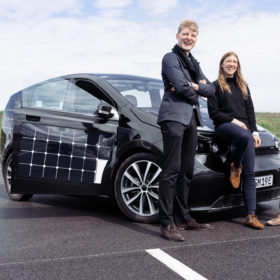
Finnish solar manufacturer gets Lithuanian factory purchase over the line
Appetite may have been lacking among private investors – at a time when global stocks are tanking amid Covid-19 and global recession fears – but the eco-friendly new Finnish government, and neighboring administrations, have stepped in to fill the breach.
