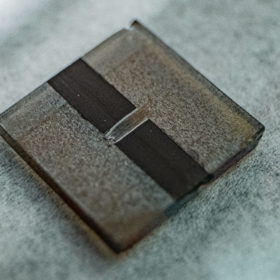
AI selecting best solar perovskites
A U.S. research team has used machine learning to optimize material composition and predict the design strategies and performance of perovskite solar cells. The researchers analyzed 2,000 peer-reviewed perovskite publications and collected more than 300 data points.

Interview with Trina Solar on BNEF Summit Shanghai 2019
Dec. 3rd, 2019, Shanghai, Bloomberg New Energy Finance (BNEF) holds its annual conference, the BNEF Summit Shanghai 2019, in Ritz-Carlton Pudong. More than 300 experts of renewable energy industry from China and other countries of the world joined the meeting.
PV Magazine had an interview with Mr. Rongfang Yin, executive vice president of Trina Solar, about Trina’s business and view.

Hanergy: From thin-film solar savior to mass lay-offs at MiaSolé, Alta, Solibro and Global Solar
Unannounced lay-offs with no pay or benefits have left more than 600 American workers, 180 employees in Germany and thousands in China unemployed and in the dark. Some of those affected have told pv magazine their story.

Cutting edge module tech promised on first, 3 GW slice of 10 GW Chinese solar installation
Huanghe Hydropower Development has started work on the first phase of a huge renewable energy project which will eventually feature 10 GW of solar generation capacity along with 5 GW of wind and 1 GW of concentrating solar power. Trina will supply 600 MW of modules to the first phase of the facility.
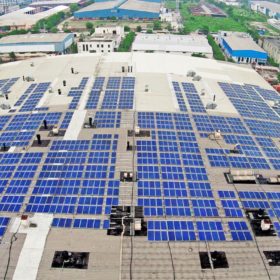
Indian developer Azure Power secures 2 GW solar project through much-criticized manufacturing-linked tender
The NYSE-listed developer must establish a total 500 MW of annual cell and module manufacturing capacity as part of the deal and has agreed with an Indian panel producer to jointly develop the production lines with Azure holding a majority stake in the enterprise. The developer has an option to double up to 4 GW of project capacity within the next four days.
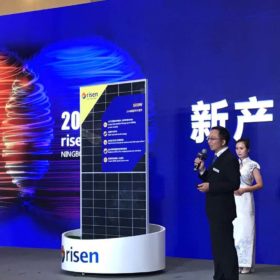
Risen Energy unveils 500 Wp+ half cut mono PERC modules
The PV manufacturer announced the development of the new solar panels, which feature new M12 series monocrystalline wafers, at a conference on Thursday in the Chinese city of Ningbo. The 50-cell modules are actually slightly bigger than 72-cell designs with 156.75 mm wafers, it said.
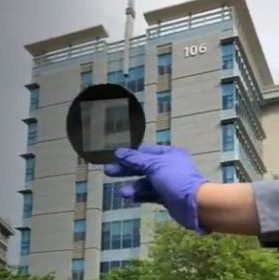
New transparent solar cell for window applications
South Korean scientists have transformed an opaque crystalline silicon solar cell into a transparent one by punching holes into it measuring around 100 μm in diameter. A neutral-colored, transparent c-Si substrate was used to develop the new cell, which is said to have an efficiency of up to 12.2%.
ARENA announces major research funding into end-of-life solar PV issues
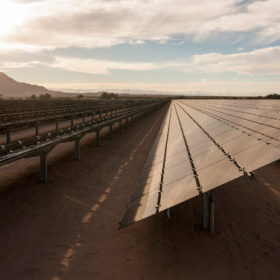
The Australian Renewable Energy Agency has announced AUD 15 million ($10.3 million) in research funding to investigate end-of-life issues for PV modules. Ultimately it is hoped that the research will increase solar PV efficiency while lowering costs.

Another one fights the dust
Scientists from Israel have used nanowires to detach particles from the surfaces of solar panels. The proposed microscopic self-cleaning technology is said to raise the efficiency of particle removal with hydrophobicity.

JinkoSolar to begin shipping Tiger bifacial modules
Chinese module manufacturer is stepping up its prowess with 314 MW of new high-efficiency Tiger modules being released to the market.
