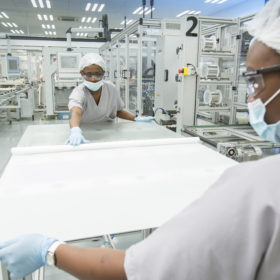
Module manufacturer responds to rumors of panel failures at 75 MW South African project
Reports of module under-performance at the Mulilo Sonnedix Prieska solar project have prompted a response from South African company Artsolar, one of the module suppliers for the plant. The project is said to be experiencing serious problems due to premature module degradation. Divian Govendar, CEO of Johannesburg-based Artsolar, said the company has not been required to replace any modules at the site.

Solar projects reprieved as Indian government declares coronavirus a force majeure
Lobby group the National Solar Energy Federation of India says around 4 GW of solar plant capacity is likely to be affected by component shortages after the outbreak of the virus in China.
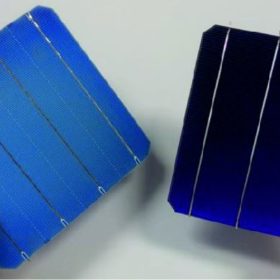
A graphene-doped tandem perovskite cell with 26.3% efficiency
Italian researchers have added graphene to the titanium dioxide electron selective layer used in a perovskite cell to increase chemical stability. The two-terminal cell was made by stacking two sub-cells which were fabricated and optimized separately.

First Solar announces surprise fourth-quarter loss, considers sale of development business
‘First Solar, at its core, is a technology and module manufacturing company,’ said Mark Widmar, chief executive of the U.S. company.
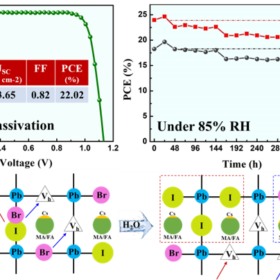
Moisture-resistant perovskite cell with 22.02% efficiency
Scientists in China have used a fluorine-containing Lewis acid treatment to develop a perovskite cell that is said to retain between 63% and 80% of its initial efficiency after 14 days under 75% and 85% relative humidity.

Hanwha officially exits polysilicon business
Hanwha Solutions has confirmed that it will shut down its polysilicon business over the course of the next year, only a week after saying that it was still evaluating its plans for the sector.

German polysilicon maker will cut 1,000 jobs
Wacker Chemie has taken the first steps of its restructuring program with the lay-offs set to particularly affect its German locations. Poor performance by the chemical company’s polysilicon business is the main cause of the crisis.
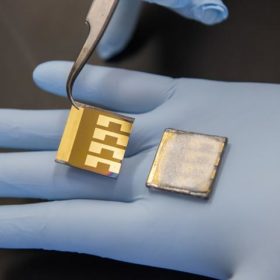
Preventing lead leakage in perovskite cells
A U.S. research group has used a lead-absorbing material to coat the front and rear of a perovskite solar cell stack. The researchers claim the films captured 96% of lead leakage when the cells were damaged.

New layer raises efficiency of heterojunction solar cells
A Dutch research team has used highly transparent, hydrogenated nanocrystalline silicon oxide layers to improve the optoelectrical performance of contact stacks in a silicon heterojunction device. The material is said to offer superior electrical as well as favorable optical properties.
Chinese giant doubles down on cell production expansion
The 5 GW of new production lines announced by JA Solar at the start of the year have now been doubled as the company also unveiled plans to rejig up to 3.6 GW of its existing facilities to accommodate bigger wafers.
