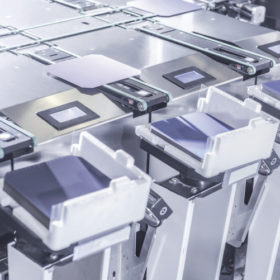
French researchers produce 348 W half-cell HJT module
Scientists at France’s Alternative Energies and Atomic Energy Commission, working with Swiss equipment supplier Meyer Burger, have hit 23.9% efficiency in large-scale production of heterojunction cells. The team also combined HJT cells with other technologies to produce a module with a 348 W power rating.
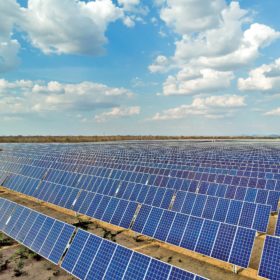
Atlas switches on 67.1 MW solar plant in eastern Brazil
The São Pedro solar complex is in Bom Jesus da Lapa, Bahia state. The plant, awarded a 20-year PPA in Brazil’s 2015 renewable energy auction, was installed with Jinko and Canadian Solar modules. The latter makes modules in São Paulo.
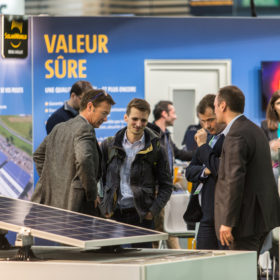
BePositive 2019 trade show – just a few weeks away – taking PV center stage
The show is expected to grow by 40% compared to last year. And the organizers say solar PV will have a higher profile than ever.
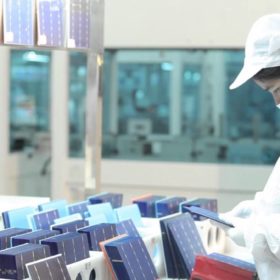
Jinko achieves 24.2% efficiency for its n-type monocrystalline cell
The Chinese module maker said the result was certified by the Photovoltaic and Wind Power Systems Quality Test Center at the Chinese Academy of Sciences. The record, Jinko said, is thanks to its high quality n-type wafers, selective doping technology and advanced fine-line printing.
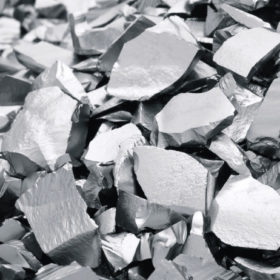
South Korea kicks off polysilicon duty talks with China
South Korean government urged China to lift import measures against its polyisilicon. China imposed duties on polysilicon from South Korea and the United States in July 2013.

California rooftop legislation lifts order book for Swedish equipment supplier
CIGS thin-film production equipment company Midsummer posted record orders in 2018. With a U.S. partner, the company noted uptake was partly due to Californian requirements to integrate PV into all new (low-rise) buildings from next year.

PV Info Link: Jinko the largest module maker of 2018
According to the Taiwanese analysts, JA Solar was number two, followed by Hanwha Q-Cells and Trina Solar in joint third. The ten largest module makers met around 70% of demand, with 66 GW of shipments.

Rejection of Azure Power bid confirms failure of India’s 10 GW ‘mega-tender’
Delhi-based developer Azure had bid for a 2 GW project on a single site – plus 600 MW of manufacturing capacity – as part of a much-hyped national 10 GW manufacturing-linked tender. The government has decided to reject the bid because it says the quoted price is unreasonable.

India mulls anti-dumping duty on Malaysian solar glass
The government may impose anti-dumping duty of $114.58 per tonne on tempered solar glass imports to provide a level playing field to domestic manufacturers.
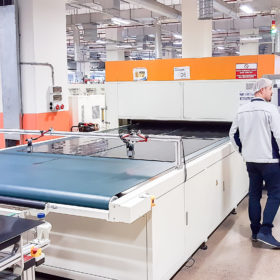
PI Berlin: Asia leading the way for module quality
Quality assurance provider PI Berlin has found the solar industry has made significant improvements to module quality in the past six years and that, perhaps surprisingly, manufacturers in China and South East Asia are setting the standard by producing higher quality modules, on average, than other regions.
