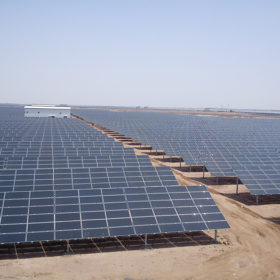
India set to add almost 60 GW of new solar by 2023
A combination of national, state and public body commitments could see the amount of PV added nationally treble on the last four-year period. But even with a new 7-8 GW added, rooftop solar will still be bringing up the rear.
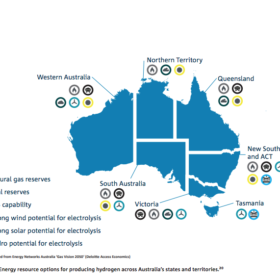
Australia has big hydrogen export opportunity
Low emissions hydrogen offers significant exporting potential for Australia, and could contribute AU$1.7 billion to domestic economy annually, shows a new report released by the Australian Renewable Energy Agency (ARENA). A separate briefing paper released by the Australian government’s Chief Scientist, Dr Alan Finkel, describes hydrogen as Australia’s next multibillion dollar export opportunity.
PV InfoLink publishes H1 2018 global PV cell/module shipment ranking
PV InfoLink has released its latest solar PV module shipment ranking for H1 2018. Chinese manufacturers continue to dominate the market, while monocrystalline module shipments increased sharply. Overall, it forecasts total PV demand of 83 GW in 2018.

EU authorizes Denmark’s scheme for mixed wind-solar auctions
The budget for the first auctions of this kind, for the period 2018-2019, is around €112 million. They are part of Denmark’s new energy strategy, dubbed “Energy for a green Denmark.”
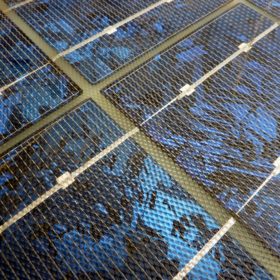
Solar cell prices decline in reaction to safeguard duties, impending MIP decision
“Significant” price movements in solar PV cells has been observed this week, in reaction to India’s safeguard duties, and the impending MIP decision, says EnergyTrend. Module, wafer and polysilicon prices, however, remain stable. In contrast, prices for li-ion batteries are set to increase by as much as 15% in Q3.

Brazil’s PV capacity tops 1.6 GW
At the end of June 2018, according to official statistics, large-scale solar capacity reached 1,307 MW, while the share of distributed PV generation (up to 5 MW), was 296 MW. Of the total capacity, 1.36 GW was connected to the grid in the last 12 months.
SunPower borrows $110 million to refinance
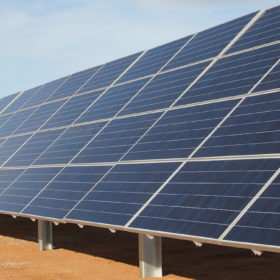
The PV manufacturer plans to pay off the high-interest ‘mezzanine loan’ with revenue from its residential lease portfolio.
Hanwha Q Cells reports lower revenue, swings to loss in Q2
At US$518.4 million, the quarterly turnover of the South Korean-German manufacturer was down 10.3% year-on-year, while its net result swung from a profit of $18.7 million in the second quarter of 2017, to a loss of $41.3 million in the latest quarter. Despite this, the outlook for full fiscal 2018 remains unchanged.
Meyer Burger posts positive earnings for first half of 2018
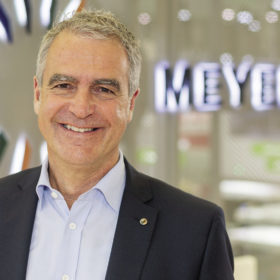
The solar manufacturing equipment maker has posted an EBIT of US$15 million for the six-month period. It marks a return to profitability for the Swiss company, after major restructuring and cost optimization programs over the past 18 months.

Nissan Brazil and Federal University of Santa Catarina to cooperate on second-life EV battery research
As the global EV market grows, manufacturers are seeking new revenue streams for used EV batteries. Applications in grid and residential storage systems have become popular. The market for second-life EV batteries is expected to reach $4.2 billion by 2025.
