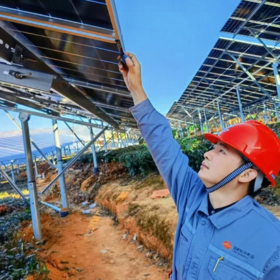
Agrivoltaics for tea plantations
CHN Energy, via its subsidiary Guohua Energy Investment, is constructing a solar project above a tea plantation in southwestern China, with the first 32 MW now connected to the grid.
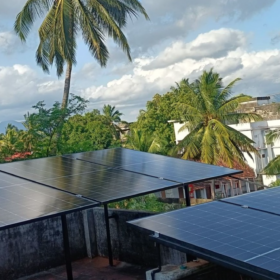
Hybrid inverters set to drive next phase of Indian rooftop solar
Energy storage for homes — anchored by hybrid inverter systems — will lead the next phase of solar growth in India. Not as an upgrade, but as a necessity for a nation building toward energy independence by 2047.
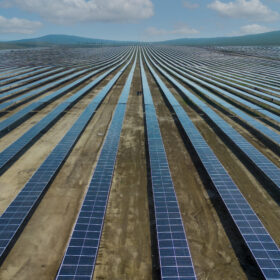
UAE’s massive solar-plus-storage project set to redefine baseload power, says Wood Mackenzie
Wood Mackenzie highlights a groundbreaking 5.2 GW solar-plus-storage project in the UAE capable of delivering 1 GW of continuous baseload power, signaling a potential shift in renewable energy deployment despite high costs. The report also forecasts strong global solar growth through 2030, including the rise of residential “balcony solar” in the U.S. and expanded solar shares in Asia Pacific and the U.S.

US expert panel examines PV Hazard Control rules and UL 3741 changes
US industry experts trace the evolution of PV rapid shutdown rules and outline how recent updates to UL 3741 are reshaping compliance pathways for rooftop and commercial solar in the United States.

Solar generates record 13% of EU electricity in 2025
EU solar generation increased by over 20% for the fourth year running in 2025, with its share in the energy mix surpassing coal and hydro. For the first time in history, solar and wind generated more energy in the EU than fossil fuels.

Self-assembling molecule for organic solar cells
A research team from Osaka Metropolitan University have developed a donor-acceptor-donor molecule that can spontaneously self-assemble into nanoscale structures and offer a more stable route to built-in p/n heterojunctions in organic solar cells.

Chinese battery makers scale up from 314 Ah to 500 Ah-plus LFP cells
China’s leading stationary storage battery manufacturers are accelerating the rollout of 500 Ah-plus lithium iron phosphate (LFP) cells, betting that larger formats can cut system complexity and lift energy density in 6 MWh-class containers, even as safety, yield, and standardization challenges intensify.
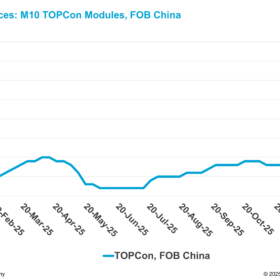
China TOPCon solar module prices climb over 30% since mid-December
In a new weekly update for pv magazine, OPIS, a Dow Jones company, provides a quick look at the main price trends in the global PV industry.

‘An immediate transition to copper is technically and economically feasible’
With silver prices rising, more large solar manufacturers are expected to switch to copper for cell metallization. Radovan Kopecek of ISC Konstanz tells pv magazine that he expects the entire industry to follow. Ning Song of the University of New South Wales says a small efficiency tradeoff may be acceptable if the cost savings are significant and do not introduce new reliability risks.
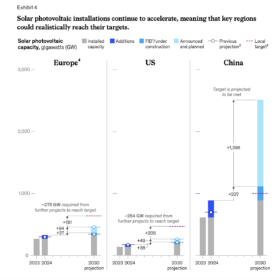
US, Europe on track for 2030 solar goals despite pipeline gaps
A report from McKinsey and Company says the relative ease of building out solar projects means the U.S and Europe are likely to meet their end-of-decade deployment targets, despite current pipeline gaps of around 205 GW and 181 GW.
