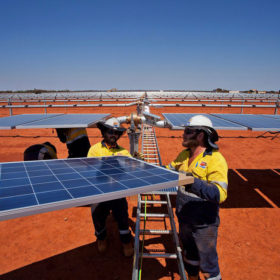
Mining sector to rely increasingly on renewables, report finds
As mining companies become more aware of the rapidly falling costs of renewables, wind and solar are set become a growing trend in powering mining operations worldwide over the coming years, shows a new report from Fitch Solutions. On the back of carbon pricing schemes, countries and companies operating in the Americas are best positioned to lead the way in the adoption of renewables in mining.
India: Industry reacts to 25% duty; developers to cough up extra $72 million
From cheer to gloom, the Indian solar industry has had mixed reactions to the Supreme Court’s interim order lifting the stay on the imposition of a 25% safeguard duty on imported solar cells and modules.

California governor signs 100% clean electricity bill
SB 100 puts California on a path to 100% zero-carbon electricity. What does that mean for the rest of the nation?

India’s Supreme Court allows imposition of 25% duty on solar imports – reports
In a significant move, which will greatly impact India’s solar industry, the country’s Supreme Court has reportedly given the go-ahead for the government to impose 25% safeguard duties on imports of PV cells and modules. The levy will be effective July 30, 2018.
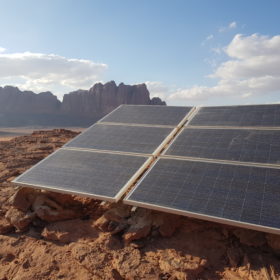
Uncertainty and challenges in Jordan’s Round 3 RE auction
Changes to Jordan’s Round 3 renewable energy auction will mean just 150 MW of capacity will be allocated for PV projects, down from 200 MW. Meanwhile, the government has accepted all 16 of the technical bids submitted in April, meaning it now hangs on price. The final results are expected soon.

The Philippines needs a cost-effective net metering policy – report
Under the current scheme, rooftop PV remains far below its huge potential in the country. Regulatory, administrative and financial hurdles are preventing more electricity consumers from installing rooftop arrays, as well as the resistance of local utilities.
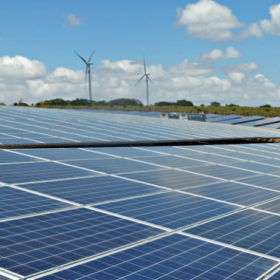
Indian PV installations fell by half in Q2
In the second quarter, India installed solar projects amounting to 52% less capacity quarter-over-quarter, due to uncertainties around trade cases, module price fluctuations and PPA renegotiations prompted by record low solar tender bids.
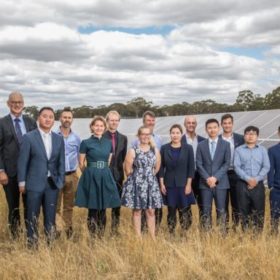
Reports: Goldwind Australia looking to offload solar, wind project pipeline
Chinese wind turbine supplier and project developer, Goldwind is looking to offload its Australian wind and large-scale solar development pipeline, according to reporting from the Australian Financial Review. The move would be one of the first international player looking to exit the Australian renewables marketplace in the face of policy chaos on a national level.
PV steps in to cover coal and nuclear power shortfalls
The sunny, dry summer has seen solar break several records and PV kept the lights on when a lack of coolant – caused by rising river water temperatures – led to the temporary shuttering of conventional power plants in France and Germany.

Industry calls for UK-EU electricity market, COP24 cooperation post Brexit
Twelve signatories from the energy and consumer goods industry have sent an open letter to the EU and U.K., calling for continued cooperation after Brexit to protect both consumer, and business, interests. The document highlights the importance of tariff-free electricity trading as intermittent renewable energy will require a higher degree of market integration.
