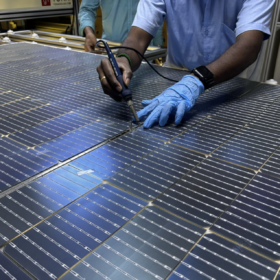
India’s solar module capacity hits 100 GW with oversupply risk by 2027
India’s solar module manufacturing capacity has reached about 100 GW, meeting domestic demand, says SBICAPS. With total capacity rising to 190 GW by March 2027 amid limited export opportunities, the market faces oversupply risks.
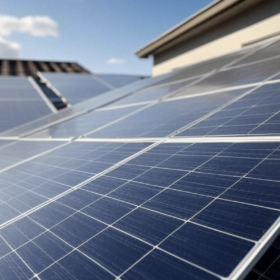
Solar self-consumption viable on all Spanish roofs, regardless of orientation
Spanish researchers have discovered that 3 kW to 5 kW rooftop solar self-consumption systems can deliver competitive payback across most roof orientations, with coplanar designs often matching the performance of optimized setups at lower cost.
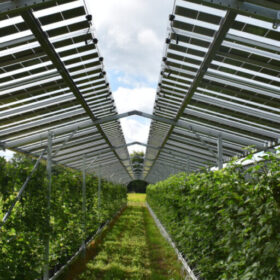
Germany offers best European policy for agrivoltaics, claim researchers
Scientists in Canada studied romaine lettuce growth under cadmium telluride thin-film solar modules with varying transparency and photosynthetically active radiation, and found Germany’s regulatory framework most effective for maximizing agrivoltaic benefits.

Sunniest state in US turns its back on the sun
Arizona holds a Guinness World Record for “most sunshine” and holds no significant gas reserves. However, despite hundreds of objections, its commission voted to repeal its renewable energy standard, letting its utilities take the wheel and head back toward more gas.

‘Women still hold only 11% of academic leadership positions in Europe’
This week Women in Solar+ Europe gives voice to Vida Engmann, Asssociate Professor at the University of Southern Denmark. Shes says ender bias affects everything from research funding and journal reviews to hiring and promotion. “It also influences our own career choices, shaped by societal expectations about roles in domestic work, childcare, and leadership,” she states.

Trump opposes solar and wind, but US renewables lead new-build capacity
US President Donald Trump took to social media this week to voice opposition to solar and wind energy. The president has taken steps to slow renewable energy growth in the United States, but it is still expected to remain the dominant source of new-build electric generation capacity.
pv magazine Homeowner Guide: Finding the right solar installer
pv magazine is compiling a guide to home solar installations, aimed at those who are interested in installing but are new to the market and want to make an informed decision. We have spoken to associations, installers and industry specialists in major solar markets across the globe to compile best practice guidance and advice that aims to be applicable to home solar installations anywhere in the world.

The International Solar Energy Society’s Solar World Congress 2025 in Brazil
The International Solar Energy Society’s (ISES) Solar World Congress (SWC) has been held biennially since the 1970s, and in November 2025 will take place in Brazil. With the sharp and continuous drop in PV costs, photovoltaics has become the lowest-cost solution in Brazil and worldwide, and this is reflected in the number of articles accepted for presentation at the SWC. The Solar World Congress program has traditionally been dominated by presentations on solar radiation and solar thermal applications, but this year, photovoltaics is the focus of most of the accepted papers. In Brazil, where large-scale hydropower plants have traditionally dominated the electricity generation mix, PV is now the second-largest generating source, and the country is adding every year the equivalent of its largest hydropower plant Itaipu, which took more than 10 years to build and reach installed capacity.
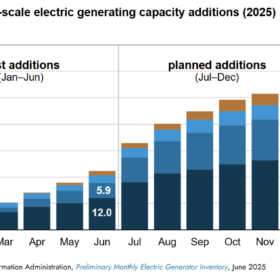
EIA projects record 64 GW US power capacity buildout in 2025
The US Energy Information Administration (EIA) says developers plan to add 21 GW of solar in the second half of 2025 alone.

Turbulent times for US energy storage
US President Donald Trump signed the One Big Beautiful Bill Act (OBBBA) on July 4, striking down key Inflation Reduction Act measures for energy storage and leaving the sector bracing for turbulence.
