
‘Mono will supply 80% of the world’s solar by 2021’
Polysilicon manufacturer Daqo has announced the start of pilot production in Xinjiang and expects to ramp up to full output by the end of the year, doubling the company’s annual capacity to 70,000 MT. Some 90% of its poly will be mono by that stage and Daqo expects 40% to be suitable for n-type products next year.
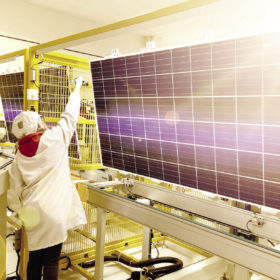
Canadian Solar raises efficiency record for mono cast cell
The result was verified by Germany’s Institute für Solarenergieforschung GmbH. The Canadian-Chinese manufacturer claims to have achieved 22.8% efficiency for its multi-crystalline P5 cell, produced with a mono cast manufacturing process.
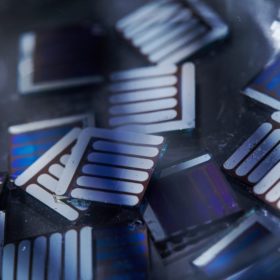
Silicon and perovskites should stick together, say Korean scientists
Researchers from the Ulsan Institute of Science and Technology have demonstrated a new method of fabricating perovskite-on-silicon tandem devices, using a transparent conductive adhesive to combine the two cells. The scientists have developed devices with demonstrated efficiencies of 19.4%, and propose strategies to bring that above 24% using existing technology.
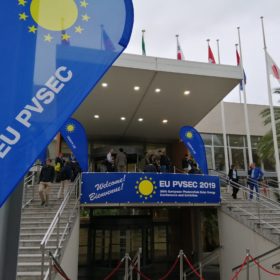
Five takeaways from EU PVSEC 2019
This week, pv magazine headed to Marseille for the 36th edition of the EU PVSEC conference and exhibition. During the week-long show, leading universities and research institutes presented their latest results to the industry and public. As the conference heads into its final afternoon, we’ve put together five key takeaways from this year’s event.

Wacker enters battery business with acquisition of 25% stake in Nexeon
The Munich-based chemical company has taken a substantial minority share in the British materials specialist to expand its silicon-based high-performance battery activity. The value of the transaction was not disclosed.
Value of local manufacturing demonstrated, utilization up but still a long way to go
Indian module manufacturers are gearing up for an end-of-year surge in solar project procurement and hoping their investments in incorporating global manufacturing benchmarks will translate into enhanced sales.

Does slew of solar mega tenders mean Gulf nations are belatedly accepting the inevitable?
With Kuwait, Qatar and even renewables laggard Saudi Arabia following in the wake of regional clean energy pioneer the UAE, a raft of huge solar tenders is entering the Middle Eastern project pipeline. Obstacles remain to overseas project developers but significant rewards are on offer.
Teaming up on tandem performance
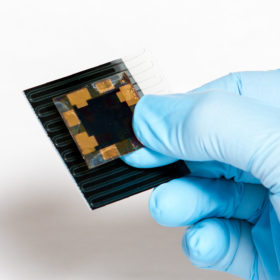
California-based Hanergy subsidiary Miasolé and European perovskite research institute Solliance have combined their thin film expertise to produce a 23% efficient flexible tandem device consisting of a semi-transparent perovskite cell on top of a flexible CIGS counterpart.

ABB and Fimer respond to UK criticism of products and customer service
The inverter businesses have responded to the letter published by the UK Solar Trade Association which was critical of the former’s products and customer service record.
HZB hits 23.26% efficiency with CIGS-perovskite tandem cell
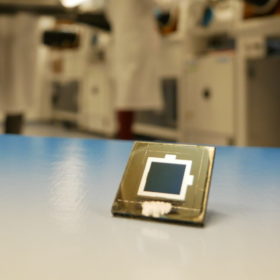
Scientists from the Helmholtz Zentrum Berlin research institute this morning presented a new world record efficiency for a tandem cell combining CIGS and perovskite technology at the EU PVSEC conference in Marseille. The development of an organic coating layer between the two semiconductors was key.
