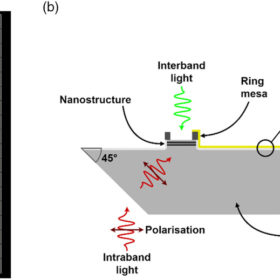
Novel design for intermediate band solar cells
A UK-Australian research group has built an intermediate band solar cell with a quantum ratchet semiconductor nanostructure that reportedly increases the ratchet band state lifetime of the device. Their new design builds on a cell structure known as the Vaquero–Stainer Device (VSD).

New model estimates PV potential for water pumping in Africa
An international team has developed a numerical model that calculates how much groundwater can be pumped by PV systems of different sizes across the entire African continent. The results show that larger PV systems do not always pump the highest volume of water.

Fraunhofer ISE founder, solar pioneer Adolf Goetzberger dies
Adolf Goetzberger, the founder of the Fraunhofer Institute for Solar Energy Systems ISE and an early proponent of photovoltaics, passed away on Feb. 24 at the age of 94.
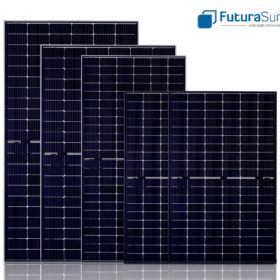
FuturaSun unveils n-type heterojunction solar modules
Italy’s FuturaSun has developed new bifacial double-glass PV modules based on n-type heterojunction (HJT) half-cut multi-busbar solar cells. The Velvet Pro line features M6 cells with power ratings ranging from 380 W to 480 W for rooftop applications. The Velvet Premium line features M12 cells, with power ratings from 615 W to 700 W for large-scale applications.
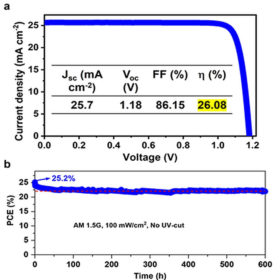
Perovskite alkylammonium chloride solar cell achieves 26.08% efficiency
The US National Renewable Energy Laboratory (NREL) has certified that a South Korean research team has achieved a 25.73% efficiency rating with a perovskite PV cell based on alkylammonium chlorides. The champion device built by the scientists reached an efficiency of 26.08%.

In search of the perfect polymer for PV backsheets, encapsulants
Scientists in Austria have examined the impact of different backsheet and encapsulant material combinations on module performance and degradation. This led them to develop a model to quantify the degradation rates of different materials, potentially helping manufacturers to identify better, longer-lasting materials for these vital module components.
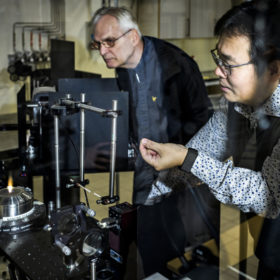
Storing solar power by incinerating metals
Scientists in Sweden have proposed the use of excess wind and solar power to incinerate metals such as aluminum and iron, in order to produce heat that could be used to generate electricity or hydrogen.
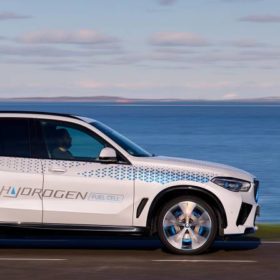
The Hydrogen Stream: BMW unveils hydrogen car demonstration fleet
BMW has launched its iX5 Hydrogen vehicle pilot fleet, with plans to start production by the end of the decade. Everfuel and Hy24, meanwhile, have launched a joint venture to accelerate hydrogen development in Scandinavia.
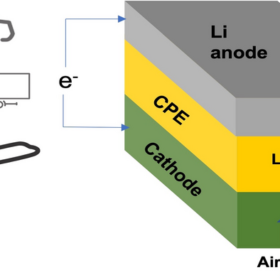
Lithium-air battery with solid electrolyte
US researchers have developed a new lithium-air battery with solid electrolyte and the potential to reach a record energy density that is nearly four times that of lithium-ion batteries. The test cell demonstrated stability over 1,000 charge and discharge cycles.
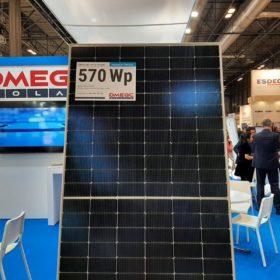
DMEGC unveils 570-580 W TOPCon solar module series
DMEGC Solar says its new tunnel oxide passivated contact (TOPCon) solar panels combine a double-glass design with half-cut n-type cell technology. It says the efficiency ratings range from 22.07% to 22.45%.
