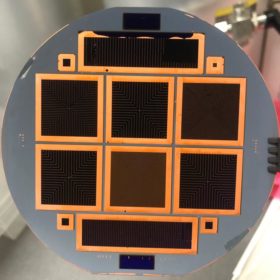
Silicon heterojunction solar cell with 23.83% efficiency via molybdenum oxide hole collector
Dutch scientists have achieved a record-breaking efficiency for a silicon heterojunction solar cell fabricated with a hole collector based on a molybdenum oxide (MoOx). They used plasma treatments to increase the presence of oxygen in the MoOx layer, to improve its electronic properties.
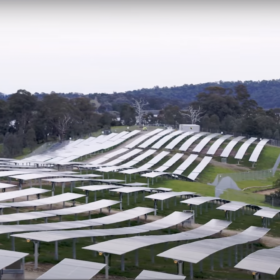
Terrain-following trackers evolving in Australia’s uneven market
Australia’s two main tracker companies, Nextracker and Array Technologies, are launching terrain-following products to mitigate and even eliminate the need for earthworks on site, opening up previously unsuitable land for solar.
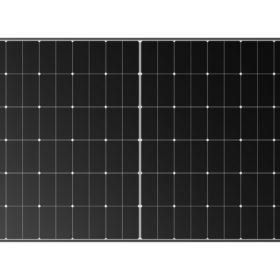
Longi launches all new back contact module, promising 22.8% efficiency
Longi has launched a series of modules featuring an all-new hybrid passivated back contact cell technology, with which it claims a maximum module efficiency of 22.8% in mass production. It will initially offer the modules in 54, 60, 66 and 72 cell formats, targeting rooftop and distributed generation applications.
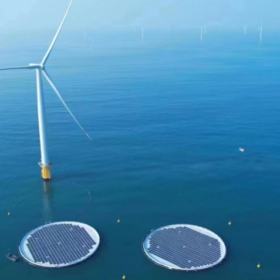
SPIC, Ocean Sun switch on offshore floating solar-wind pilot
State Power Investment Corp. (SPIC) has started operating the world’s first offshore floating solar plant integrated with an offshore wind turbine, at a pilot site off the coast of China’s Shandong province. It features floating PV tech from Norway’s Ocean Sun.
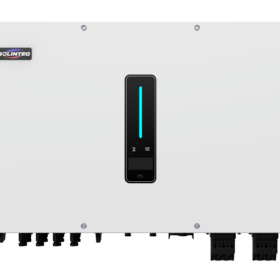
Solinteg unveils hybrid inverter series for C&I applications
Solinteg is offering five versions of its new three-phase hybrid inverters, with nominal power ranging from 25 kW to 50 kW, an efficiency rating of 98.8%, a European efficiency of 98.3%, and up to 4 MPPTs.

The Hydrogen Stream: Researchers identify light-triggered coupled oxygen evolution mechanism
Researchers in Singapore have developed a new light-triggered coupled oxygen evolution mechanism that builds on past oxygen evolution research. Oman, meanwhile, has announced a new hydrogen strategy.

Uninterrupted PV generation without storage
An Israeli scientist has proposed a way to achieve uninterrupted PV power on the moon without using energy storage. The proposal involves the installation of PV panels around a 360-degree latitudinal ring close to one of the moon’s poles. There would be no inter-array shading, and static vertical PV arrays and arrays mounted on single-axis vertical trackers could be viable mounting structures.
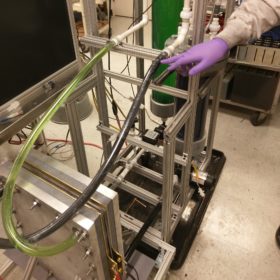
Novel redox flow battery paves way for low-cost storage
US researchers have facilitated the decoupling of power from energy design by incorporating a conducting carbon slurry in the negative electrolyte of an all-iron flow battery. In a new study, they describe the design considerations for slurry iron redox flow battery scalability.
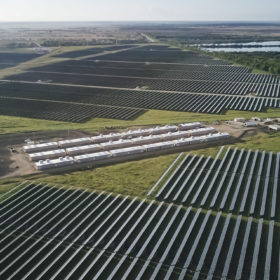
Operations begin at 87 MW solar-powered bitcoin-mining center
Aspen Creek Digital, a US bitcoin miner, has started operations at a 30 MW bitcoin data center powered by an 87 MW solar park in Texas. The project is the company’s second solar-powered bitcoin-mining center.
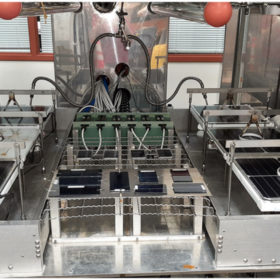
Putting bifacial modules to the test
US scientists recently put different bifacial solar cells and modules through a series of tests at elevated temperature, humidity, voltage and mechanical stress levels. The tests revealed a range of light-induced and potential-induced degradation mechanisms that modules will likely suffer in the field.
