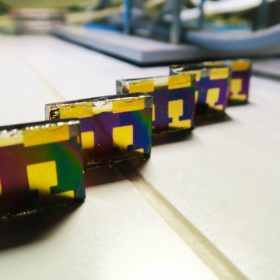
Perovskite solar cells need proteins
A U.S. research team has used protein bacteriorhodopsin to improve the efficiency of what it called ‘bioperovskite’ solar cells. The scientists used Förster Resonance Energy Transfer to predict the strength of long-range excitonic transport between the perovskite and protein layers.

PV against cancer
Research from the United States has demonstrated how PV technology can be used to kill cancer cells. Although still at an embryonic stage, the findings of the study and initial test results suggest solar power could be an effective tool in relation to light-activated fluorescent dyes for disease diagnosis, image-guided surgery and site-specific tumor treatment.

UK’s Labour announces plans for 22 GW of new solar capacity by 2030
Although PV trails wind and nuclear in terms of its anticipated future footprint, the opposition party’s attempt to outflank left of center rivals on climate change has resulted in one of the world’s most ambitious national roadmaps towards a zero-carbon future.
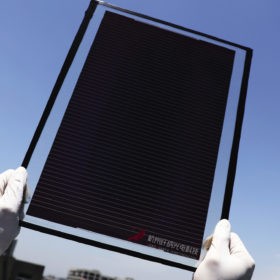
Microquanta achieves 14.24% efficiency with large-area perovskite solar module
The four-year-old Hangzhou-based business says it already has a 20 MW perovskite module pilot line and is working on a mass production facility in the city of Quzhou.
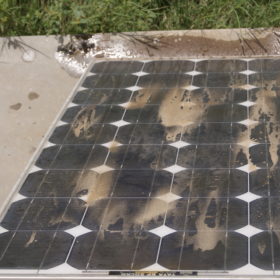
Promising soiling mitigation solutions should not be left to gather dust
A study has estimated the cost of PV project soiling may increase from €3-5 billion last year to €4-7 billion by 2023 due to more extensive deployment in high insolation and soiling-affected regions, such as China and India. The authors of the paper outlined the potential of soiling mitigation technologies while stressing more R&D is needed to reduce costs and for the adoption of such measures on a larger scale.

Ambibox reports efficiency world record for solar DC charging of electric off-road buggy
A German start-up achieved more than 99% efficiency when charging a vehicle developed by the Bochum University of Applied Sciences with electricity from solar cells. Ambibox’s DC charging technology was used in a research project in the Australian desert.
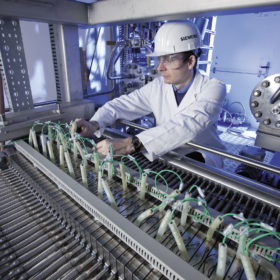
Fate of green hydrogen depends on ever cheaper renewables – for now
Analyst WoodMac has spelled out the urgent need to decarbonize the global hydrogen production industry. While the fuel can offer a sustainable grid balancing act for intermittent renewables, in its current fossil-fuel driven form it is pumping out more than 800 megatons of carbon into the atmosphere every year.

Highview Power to build UK’s first large scale ‘cryogenic’ energy storage facility
The long-duration energy storage provider plans to eventually build a portfolio of 50 MW/250 MWh liquid air systems throughout the United Kingdom.

Carbon nanotubes provide a boost to perovskite solar
Scientists at the Tokyo Institute of Technology have developed a carbon nanotube which forms a strong junction with a lead-halide perovskite, improving performance and stability.

PV performance projections for the 21st century
A study has divided the world into 12 climate zones on the basis of the Köppen–Geiger classification map. The paper confirmed Chile’s Atacama region has the world’s highest solar radiation but also showed the region with the highest performance ratio for PV systems was near Moscow.
