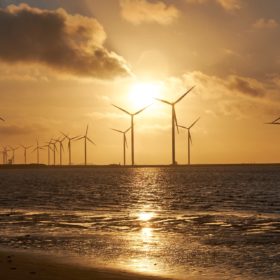
First off-shore PV project launched in the North Sea
A floating solar array will be located in the North Sea near an aquaculture and an offshore wind power facility. The €2 million pilot project is being developed by a consortium including Tractebel, Jan De Nul Group, Deme, Soltech and Ghent University.
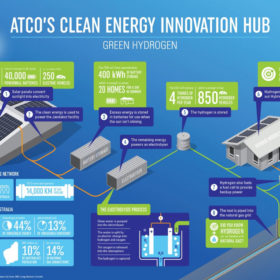
Green hydrogen joins natural gas in Australian pipelines
Canadian gas giant ATCO has unveiled its Clean Energy Hub in Jandakot which will explore the potential of hydrogen for home use in gas appliances. On the same day, the Western Australian government has launched a renewable hydrogen strategy and announced the creation of a $10m green hydrogen fund.

CBEA lets loose first $5.5 million for 60 minigrids in Tanzania
Crossboundary Energy Access (CBEA) was established in January with large investment contributions from Rockefeller and Shell Foundations. The funding facility, which said it would work to unlock $11 billion in funding for the electrification of 100 million people in Africa, has penciled its first transaction with PowerGen Renewable Energy.
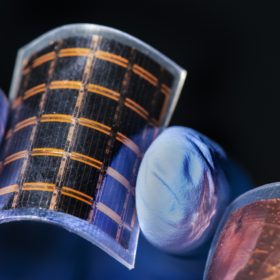
Sensing an opportunity for indoor PV
A new paper published by scientists from the Massachusetts Institute of Technology examines the potential for integrating small solar cells into the wireless sensors needed to power the fast-growing internet of things (IoT) ecosystem, many of which are located indoors. This market could represent a unique opportunity for thin film PV technologies, and perovskites in particular, to reduce the risk inherent to ramping up commercial scale production.

UK needs 13 GW of DSR, smart EV charging and V2G ramp up for net zero goal
… and it will be quite an effort. The U.K.’s grid operator, National Grid, released a new report on possible energy system transformation pathways, amidst growing public concern over climate change. Ramping carbon emissions reduction targets up from 80% to 100% prompts technical challenges. These can be overcome but will require full alignment of policy effort and individual awareness and decision making.
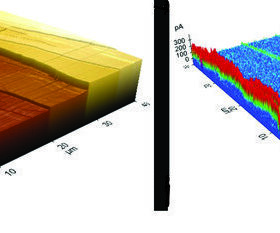
Another route to high performance perovskites
Scientists at Pennsylvania State University have developed a new class of perovskite materials, which they say exhibits unique properties that could have several implications for the development of perovskite solar cells, as well as other electronic applications.

Scientists set new efficiency record for single crystal perovskite
Scientists at Saudi Arabia’s King Abdullah University of Science Technology have set a new efficiency record of 21.09% for a single crystal perovskite. The researchers say this highlights a place for the technology to develop alongside the multicrystalline versions which are progressing toward commercialization.
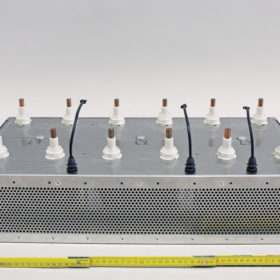
The weekend read: Transistor transition
In pursuit of a lower levelized cost of energy for the next generation of inverters, some manufacturers have turned to acquiring considerably more expensive semiconductors. While this may sound like a misstep at first, the trick could be pulled off — though not easily, and not always — yet.

Waste heat is not cool, say US scientists
Engineers at the University of Utah have developed a tiny device which they say could increase the performance of PV panels and other electronic devices by converting energy lost as heat back into electricity.

China auction allocates subsidies for 22.7 GW of solar with lowest bid of $0.0407/kWh
China’s National Energy Administration has given the greenlight to 3,921 ground-mounted and distributed generation projects. The approved energy price bids ranged from $0.0407 to $0.080, depending on system size, for an average price of $0.048.
