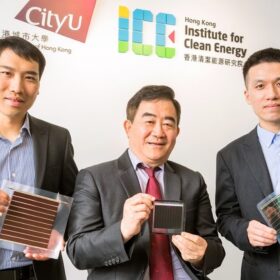
Monolithic perovskite-organic tandem solar cell achieves 24.27% efficiency
Researchers at City University of Hong Kong have developed a monolithic perovskite-organic tandem solar cell with a wide-bandgap subcell that reportedly provides “remarkable” stability. The tandem device achieved one of the highest efficiencies ever reported for this type of solar cell technology.

Solar PV flooring for residential, commercial use
Turkey-based Ankara Solar Energy launched its own brand of walkable PV flooring for residential and commercial projects. Its 30 W and 120 W square panels with anti-slip glass front covers are sold with a supportive pedestal system, and are now available for the European and U.S. markets.
U.S. solar car race success for two Canadian teams
Solar car teams from Canada outperformed in two categories of the latest Electrek American Solar Challenge. The student team from Polytechnique Montréal won first in the multiple occupant vehicle category, and the students from École de technologie supérieure won second place in the single occupant vehicle category.

Scientists classify weather types based on extreme photovoltaic output events
Scientists used a year’s worth of data from East China to analyze what weather conditions affect abnormal, high, and low PV output days. They also constructed a simple extreme output prediction model and examined the atmospheric circulation anomalies corresponding to extreme output events.
Ternary organic solar cell based on dimerized small molecule achieves 18.12% efficiency
A team from the Southern University of Science and Technology in China has designed a small molecule donor to act as a third component in ternary organic cells. It helped to achieve a power conversion efficiency of 18.26% when fabricated with a PM6:BTP-eC9 organic solar cell.

The Hydrogen Stream: MIT shows hydrogen can be made from aluminum, caffeine
Researchers from the Massachusetts Institute of Technology (MIT) claim they can efficiently produce hydrogen from recycled aluminum cans in seawater by combining them with gallium-indium and caffeine.
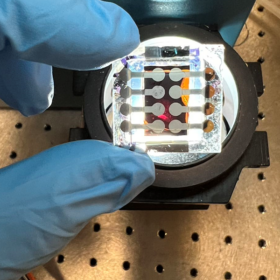
All-perovskite tandem solar cell based on tin-lead perovskite achieves 28.8% efficiency
An international research team has developed an all-perovskite tandem PV device that reportedly shows reduced recombination losses in the cell’s bottom device and remarkable stability. To improve the perovskite solar cell’s surface, the scientists created partially non-conductive and non-functional areas that protect the perovskite area underneath from becoming defective.
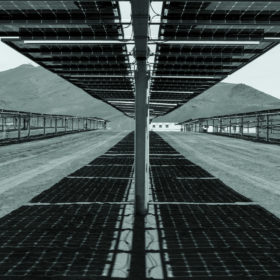
Bifacial tracking systems dominate utility-scale PV market
The latest report from the International Energy Agency’s Photovoltaic Power Systems Programme (IEA-PVPS) covers best practices for the optimization of bifacial PV tracking systems and discusses key areas for improvement.
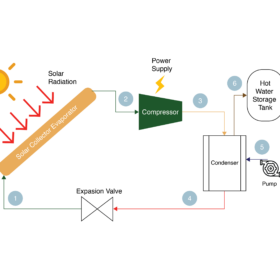
Direct expansion solar heat pumps for residential applications
Scientists in India have conducted an extensive review of all direct expansion solar heat pump technology in an effort to broaden its residential adoption. Such system can psroduce hot water from 15 C to 60 C at an average coefficient of performance of 1.5 to 4.5.
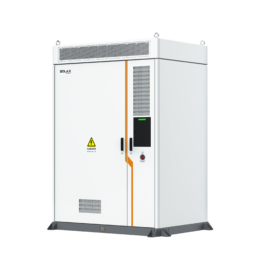
SolaX releases new 215 kWh storage system
SolaX has released a new 215 kWh storage system featuring 280 Ah lithium iron phosphate (LFP) battery cells, with 100 kW of rated AC power and a maximum efficiency of 98%.
