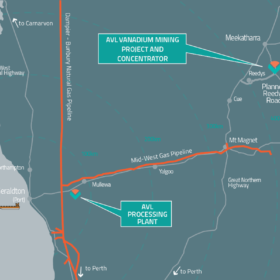
Globally significant vanadium mine in Australia ‘bankable,’ construction slated for 2023
A major Western Australian mine targeting the global vanadium battery market was this week found to be bankable, with feasibility studies confirming the project’s “strong commercial case for development,” its owner Australian Vanadium Limited said.
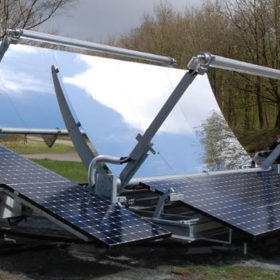
Concentrating solar power system for building applications, usable with PV
Conceived by a German start-up, the system is claimed to achieve a 75% efficiency in converting direct radiation into heat. It may be either equipped with solar trackers or photovoltaic modules, which would both occupy the same space on the front and lateral sides of the installations.
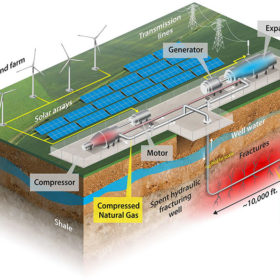
Storing renewables in depleted oil and gas wells
US researchers have proposed the use of hydraulically fractured oil and gas wells to store renewable energy via compressed natural gas, with the levelized cost of storage potentially coming in at $70/MWh and $270/MWh. They said wells could also be used to store other renewable gases such as carbon dioxide or hydrogen in the future.
Low-temperature perovskite solar module with 19.1% efficiency
Researchers have developed a PV module with with an efficiency of 20.72%, based on tin oxide (SnO2) as an electron transport layer, an organometal halide perovskite layer, organic halide salt phenethylammonium iodide (PEAI) as a passivation agent, and Spiro-OMeTAD as the hole transport layer (HTL).
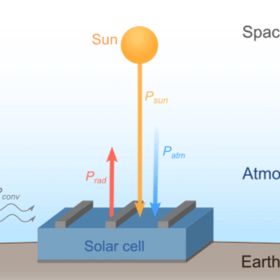
Radiative cooling for PV modules – challenges and prospects
A group of international scientists has investigated the potential use of radiative cooling in PV systems, in a newly published review focusing on challenges and opportunities for the passive cooling technology.

Indian startup unveils zinc-based battery tech for stationary applications
A startup incubated at the Indian Institute of Technology Kanpur has introduced ZincGel battery tech, which could offer significant savings for owners of two-wheel electric vehicles.

The weekend read: Plans for a fully fledged European PV supply chain
While Europe was previously a leader in the manufacturing of solar cells and modules, the plans falling into place this year already represent a scale never before seen on the continent. And they’ll need that scale if Europe is to meet expected demand for new solar over the coming decades, without relying heavily on imported products and components. Many of the technologies at the center of these plans are brand new as well; pv magazine looks at a few of the innovators planning to scale up alongside more mainstream players, and how these fit into plans for a fully fledged European PV supply chain.
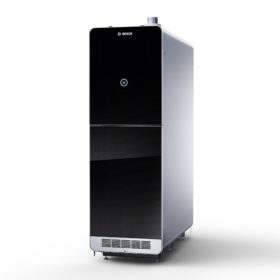
Bosch unveils hydrogen-compatible stationary fuel cell system
Bosch’s new solid oxide fuel cell prototype has an electrical efficiency of more than 60% and an overall efficiency above 85%. It also has a targeted power output of 10 kW and can produce up to 3 kW of thermal energy.

Quantum adjustments for 23.9%-efficient inverted perovskite solar cell
Scientists in Canada fabricated a perovskite solar cell based on an inverted structure that achieved 23.9% efficiency, and maintained 92% of its initial performance after 500 hours of accelerated aging tests. By carefully controlling the thickness of the perovskite layer, the group was also able to gain control of “quantum mechanics” properties such as the movement of electrons within the layer and the wavelengths of light absorbed.
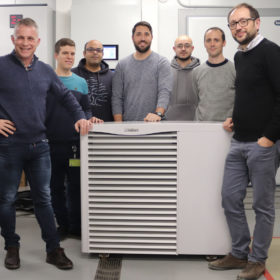
Residential heat pump produces water up to 75 C
Scientists in Spain have developed a new heat pump that can produce 6.49 kWh of heat for each kilowatt-hour of power it consumes. The device could generate hot water at a temperature of up to 75 C.
