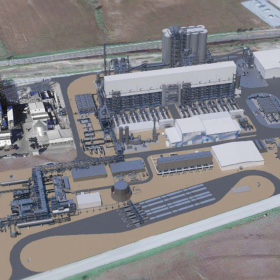
The Hydrogen Stream: China Yuchai unveils hydrogen engine, Monolith secures $1bn to expand Nebraska facility
Elsewhere, the ‘world’s first hydrogen racing truck’ has set out on this year’s Dakar Rally, with sponsorship from Saudi Aramco, and French hydrogen equipment business McPhy has been selected as preferred supplier for the GreenH2Atlantic project in Portugal.

Heat-protective film to reduce solar module temperature by 3.5 degrees Celsius
An international research team has tested a holographic film based on prismatic concentrators that was presented by Russian scientists last year and is claimed to significantly reduce the operating temperature of solar modules, including that of thermal-photovoltaic devices. According to the new findings, the film is able to lower the operating temperature by around 3.5 degrees Celsius.
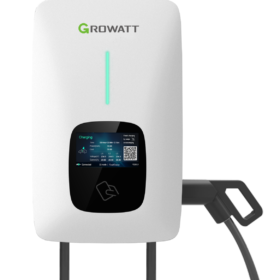
Weathering the solar industry storm: How Growatt overcame 2021’s challenges
Growatt has been on an upward trajectory, recording an over 60% revenue increase in 2021, despite the many challenges posed in the solar industry. Lisa Zhang, global marketing director tells pv magazine how the Chinese PV inverter manufacturer overcame semiconductor chip shortages and rising costs amidst a global pandemic in addition to discussing key markets and new inverter products.
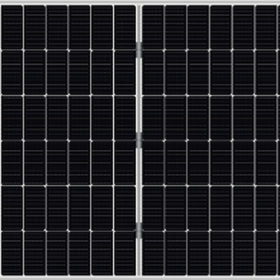
Jolywood launches 615W TOPCon solar module and all-black panel for residential segment
The Chinese manufacturer has launched two new bifacial products based on its n-type TOPCon 2.0 cell technology. The JW-HD156N panel has a power output of 615W, a front side efficiency of 22% and is intended for utility scale projects. The second product, called JW-HD108N, is an all-black panel with a power rating of 425W, for the residential segment.

Viessmann and 50 Hertz integrate heat pumps to stabilize German grid
The partner companies say smart heat pumps can offer flexible capacity that network operators can use for safe operation and households could also benefit from a reduction in electricity prices.
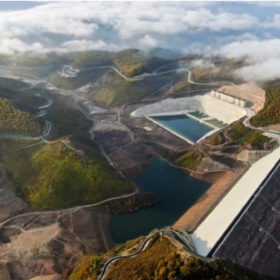
State Grid of China switches on world’s largest pumped-hydro station
Located in China’s Hebei province, the 3.6GW facility consists of 12 reversible pump generating sets with a capacity of 300MW each and has a power generation capacity from storage of 6.612 billion kWh.
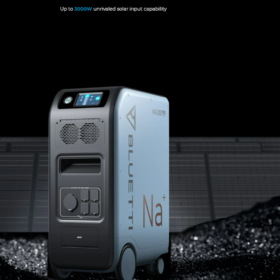
Bluetti launches sodium-ion solar generator
Bluetti’s NA300 sodium-ion solar generator offers thermal stability, fast-charging capacity, low-temperature performance, and integration efficiency.
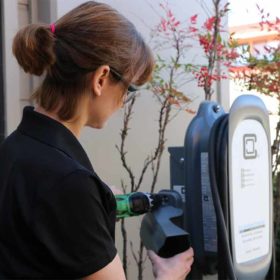
Enphase enters EV charging market
The completed acquisition of ClipperCreek launches Enphase Energy into the fast-growing market for electric vehicle charging systems.

PV-powered heat pump system for commercial swimming pool heating
Researchers in Jordan have designed a solar-assisted heat pump system for swimming pool heating at a hotel in the coastal city of Aqaba. They found that the system has a payback time of only 1.94 years and that total profits after ten years of operations may reach around $1.88 million.

Solar for polytunnel greenhouses
Israeli researchers have tested organic PV modules to power polytunnel greenhouses and have found that they might offer advantages over conventional crystalline silicon, despite their lower efficiency rates. They have lower operating temperatures but are subject to degradation, due to the mechanical stress caused by the wind-induced movement of tunnel sheeting.
