
The Hydrogen Stream: EU aims for €1.80/kg by 2030, BP announces green and blue hydrogen production in the UK
Also, Petroleum Development Oman wants to become the main player in the country’s plans to become a hydrogen hub and Emirates Global Aluminium says it wants to increase its hydrogen consumption.
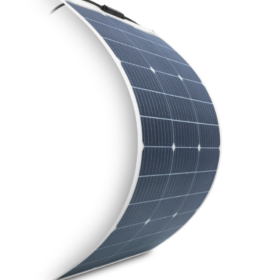
Flexible 200 W solar module for boats, caravans
Offered by German provider Green Akku, the module is only 2mm thick and has a weight of between 1.45 and 3.63kg, depending on size. It can can be bent up to 50 degrees.
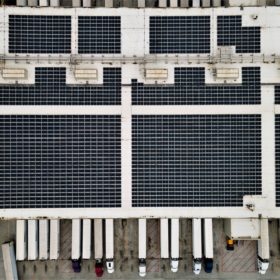
Coupling photovoltaics with linear generators
A 3.3 MW rooftop PV array and 480 kW of linear generators are currently being used to cover 100% of the electricity needs of a logistics facility in California. The hybrid energy system is relying on a linear generator technology provided by U.S. specialist Mainspring Energy that converts mechanical energy into electrical energy.
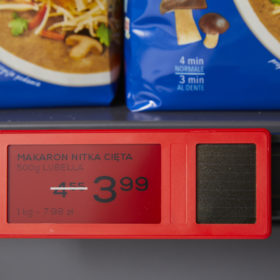
Perovskite solar cells for electronic shelf labels
The solar-powered electronic shelf labels are intended for use in retail stores. Users are enabled to change prices centrally and synchronously across all retail stores within a chain.
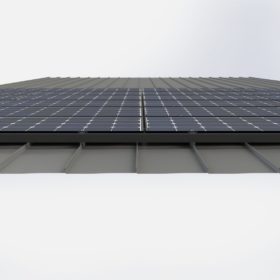
Module skirt for PV arrays built on seam metal roofs
The PVonceal module skirt protects all of a module’s electrical components while maintaining sleek aesthetics for the lifetime of the installation.
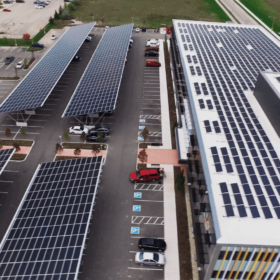
U.S. decarbonization goals hinge on scaling up heterojunction solar cell tech
HJT technology could fill an innovation gap in the residential and commercial rooftop PV market, and boost U.S. solar leadership through domestic manufacturing of cells and modules.
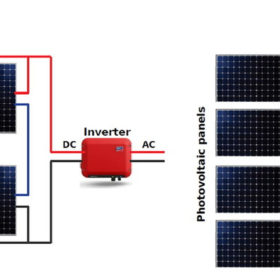
Micro-inverters vs. string/central inverters
A French research group has compared the performance ratio of 100 PV systems relying on micro-inverters with that of 100 installations relying on string/central inverters. It found the performance ratio is around 79% for both system typologies and that arrays with micro-inverters are more sensitive to environmental factors.

Canadian mining company acquires 10 vanadium sites in Morocco
Canada-based Elcora said the transaction will enhance its mining operations and energy storage business.

The Good, the Bad and the Ugly: defects in perovskite solar cells
Scientists in the UK delved deep into the structure of a perovskite solar cell, looking to understand the complex relationship between the materials that make up the perovskite layer, and the role of different defects in both limiting and improving performance. The findings could allow for new perovskite materials that are specially structured to maximize PV performance.

Color-tunable transparent silicon solar cell with 7.38% efficiency
Designed for BIPV applications by scientists in Korea, the solar cell is based on a 100μm-thick n-type silicon wafer and has a bending radius of 3-6mm.
