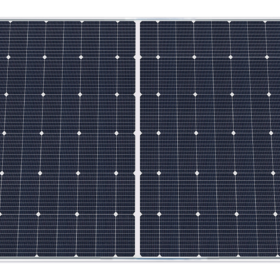
Indian solar manufacturers go big on high-output modules
Adani Solar, Jakson, Premier Energies, Vikram Solar, Waaree and other Indian manufacturers are showcasing their high-output modules ranging from 500 W to over 600 W at this year’s Renewable Energy India Expo 2021.
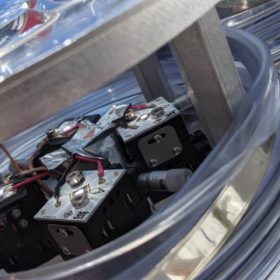
CPV module with improved short-circuit current via microstructured encapsulant coatings
A Canadian consortium led by the Sherbrooke University has developed a CPV panel with improved light absorption through a microstructured anti-reflecting coating consisting of a monolayer of silica beads, which they claim can improve the device’s short-circuit current by up to 3.7%. The module is based on III-V solar cells.
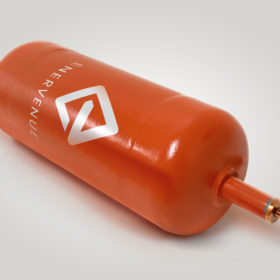
Nickel-hydrogen battery for large scale renewables
U.S. start-up EnerVenue has secured funding to build a gigafactory to produce nickel-hydrogen batteries for large scale renewable and storage applications. The battery has an efficiency ranging from 80 to 90%, depending on the cycle rate, and its energy density per square foot is equal to, or better than lithium-ion batteries, according to the company.
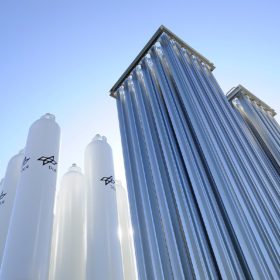
PV-generated hydrogen cost projected to drop to €0.7 and €1.8/kg by 2030
Green hydrogen cost may reach between €0.7 and €1.8/kg by 2030 and €0.3 and €0.9/kg by 2050, according to a European research team led by the European Technology and Innovation Platform for Photovoltaics. The scientists found that the levelized cost of hydrogen (LCOH) could drop from around €0.031-0.081/kWh currently to €0.02-0.05 by 2030 and €0.01-0.027 by 2050.
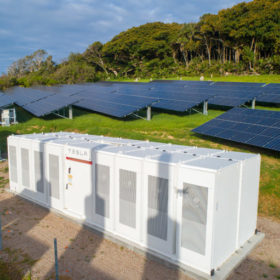
Solar microgrid makes remote Australian island less dependent on diesel
Until this year, Lord Howe Island was totally reliant on diesel generation for its electricity. A solar-powered hybrid microgrid, integrated into the island’s supply since April, has now been declared a resounding success.
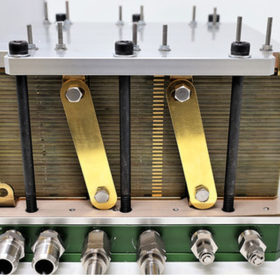
The Hydrogen Stream: New fuel cell tech for uncrewed ships, and a solar-powered hydrogen valley in southern Italy
A printed circuit board-based hydrogen fuel cell for use in autonomous boats and ships has been engineered by a British consortium, and Italian energy companies Snam and Edison want to set up a 220 MW green hydrogen production plant powered by 380 MW of solar in Apulia.

Heat pumps can be standalone solutions even in cold climates
The Massachusetts Clean Energy Center (MassCEC) showed, through a pilot incentive program, that whole-home heat pumps are a feasible solution for heating when switching from gas. Project costs, however, were found to be higher than expected.

Movable solar power station for off-grid applications
The modular power station comes with two lithium iron phosphate (LFP) batteries and has a capacity of 6 kW/24.6 kWh. It relies on a 3 kW pure sine wave inverter which the manufacturer said is able to adjust the AC charging rate.
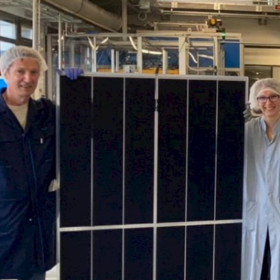
CEA-INES unveils shingled heterojunction PV panel with 21.41% efficiency
The module is claimed to be one of the top five most performant heterojunction solar modules, in terms of power density, with the champion panel achieving 214.15 W/m² and the average device 209.5 W/m². The panel showed an efficiency ranging from 20.95% to 21.41%.
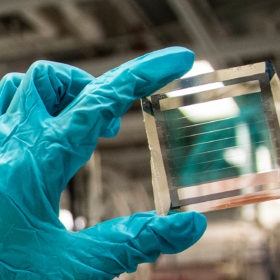
Semi-transparent organic solar cell for window applications
Developed by U.S. scientists, the 10%-efficient device is intended for applications in solar windows and promises efficiencies close to 15%. According to its creators, the cell retained 80% of its efficiency after 1,900 hours at 55 degrees Celsius.
