
Floating PV mounting structure for harsh climatic conditions
Developed by Chinese specialist Mibet, the floating PV structure can reportedly endure wind and snow loads of up to 42m/s and 1KN/㎡, respectively, in all water environments. It was recently deployed in Poland, at a location where temperatures may reach as low as 40 degrees Celsius.
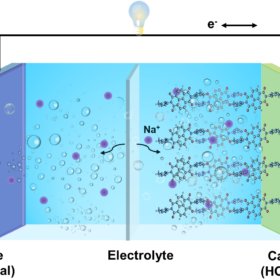
Ultra-stable sodium-ion storage via organic electrode materials
A research team at China’s Soochow University has used hydrogen-bonded organic frameworks to make sodium-ion batteries even more sustainable and affordable while prolonging their lifespan to over 10,000 cycles.
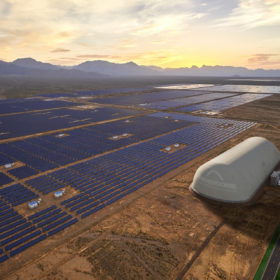
Storing solar power with compressed carbon dioxide
An Italian company has developed a system that can store energy from wind, solar and grid electricity by compressing and using CO2 without any emissions. The system draws CO2 from an inflatable atmospheric gas holder, stores it, and uses it to produce power again, when demand for stored energy arises.
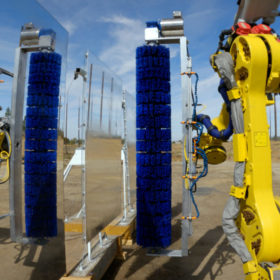
New tank design, autonomous robot for concentrated solar power plants
Two different technological developments were announced this week for concentrated solar power technology. In Australia, a consortium led by Vast Solar filed a patent for a new tank design for thermal energy storage systems. And in the United States, Heliogen announced the rollout of robots to install and clean projects.
Google lends a hand in the search for new solar cell designs with open-source tool
Scientists in the United States developed a computer simulator that can calculate the conversion efficiency of different solar cell materials and configurations – helping to guide research and optimization of new cell designs. The simulator is available to researchers as an open-source tool to save time and spot the best opportunities for optimization of any given approach.
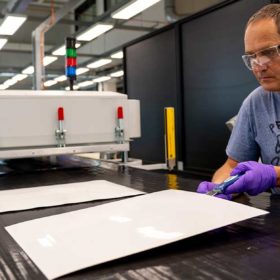
Recyclable, back-contact solar panel from the Netherlands
Conceived by a Dutch consortium, according to Design for Recycling guidelines, the panel is being developed with two different encapsulants, one for the front of the module, which joins the glass and cells together; and a slightly different formulation for the back of the module, which attaches cells and backsheet together.
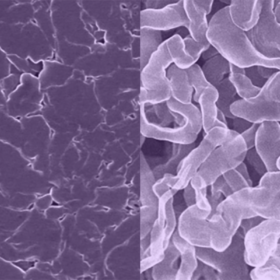
Sodium battery research tackles formation of dendrites
Sodium batteries, an increasingly competitive area of research, have emerged as a low-cost, lithium-free energy storage alternative based on abundant, more environmentally friendly materials. A pair of new research papers addresses some of the remaining hurdles to widespread adoption, such as the formation of dendrites on the anode.
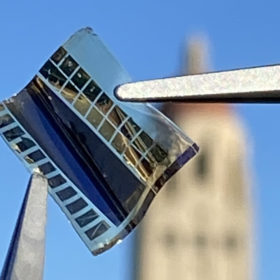
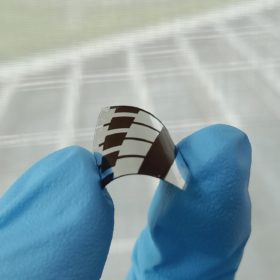
Flexible metal dichalcogenide solar cell with 5.1% efficiency
Stanford scientists have fabricated a transition metal dichalcogenide (TMD) solar cell that is claimed to overcome the typical issue of this kind of PV device, the so-called Fermi-level pinning. They used graphene contacts to mitigate this phenomenon and achieved a record power per weight of 4.4 W/g.
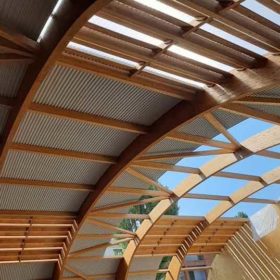
Deploying solar on curved metal roofs
Midsummer and Medacciai are developing a BIPV solution for curved metal roofs in southern European markets, through a five-year deal.

Grid stability and 100% renewables
New research from Stanford University professor Mark Jacobson seeks to remove any doubts about grid stability in a world powered entirely by renewable energy. The latest study models 100% wind water and solar powered grids across the United States, finding no risk of blackouts in any region and also broad benefits in cost reduction, job creation and land use.
