
Dutch gas giant begins storing hydrogen in underground salt cavern
Operated by Gasunie, the underground storage facility is located near Veendam in the province of Groningen and should be fully operational in 2026. Tests will be run until spring 2022.
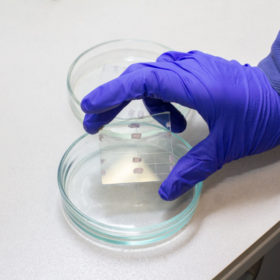
Russian scientists achieve 21.1% efficiency in perovskite solar cell via Mie-resonant silicon nanoparticles
A Russian-Italian research group has developed resonant silicon nanoparticles that are claimed to improve the performance of perovskite solar cells. These particles serve as nanoantennae – they catch light and it resonates inside them, which amplifies the cell’s light absorption.
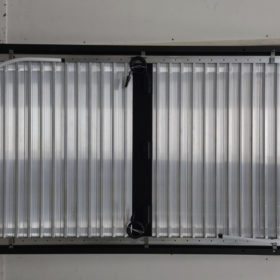
Hybrid PV-thermal modules providing heat source to brine-water heat pumps
Developed by Dutch company UseAllEnergy, the module is fabricated with a heat exchanger placed on the rear side that works as a heat source for a brine-water heat pump. Thanks to this innovation, the heat pump does not need to get heat from a borehole yet can still generate sufficient thermal energy. The solution is claimed to be easy to install and also to be suitable for retrofits.

Solar-powered delivery van with 400 km range
Swedish start-up Clean Motion is seeking to commercialize an electric delivery van that is also powered by IBC solar modules placed on its roof. The vehicle is claimed to have a 400 km range, of which up to 130 km are provided by the PV array.
Energy storage projects can apply for inclusion in Euro network plan
Electricity transmission system operators from 35 European countries have opened the call for new storage and long-distance network projects that wish to be included in their next, Europe-wide ten-year grid development plan.
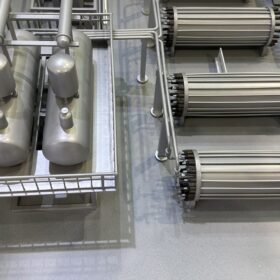
Australian scientists seek to verify tech claimed to improve hydrogen fuel cell efficiency by 60%
From pv magazine Australia Queensland’s University of Technology (QUT) is working on verifying Titan Hydrogen’s claims its patent-pending technology will “effectively double” vehicles’ driving ranges by enabling a fuel cell to produce more electricity from the same amount of hydrogen. The Australian-based company claims its technology could increase the capacity of fuel cells by up […]
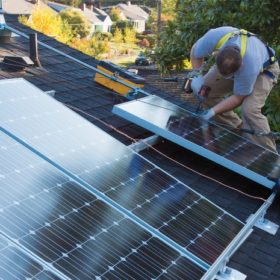
Residential rooftop solar 101: From azimuth to zoning
Join the solar revolution, but do so with the most current insight on equipment, cost, and system design. Bookmark this page and refer to it often as your project moves forward.

Pakistan wants to build solar plants on canals
Pakistan’s Punjab region is planning to build solar plants on top of canals across several locations. Experts are now being sought to conduct a feasibility study and identify potential locations.
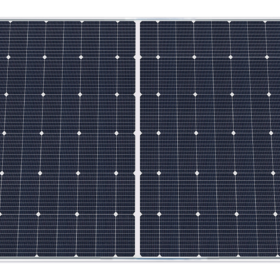
Indian solar manufacturers go big on high-output modules
Adani Solar, Jakson, Premier Energies, Vikram Solar, Waaree and other Indian manufacturers are showcasing their high-output modules ranging from 500 W to over 600 W at this year’s Renewable Energy India Expo 2021.
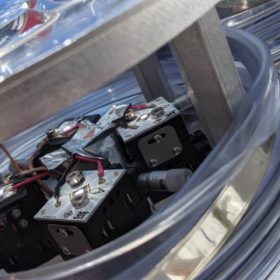
CPV module with improved short-circuit current via microstructured encapsulant coatings
A Canadian consortium led by the Sherbrooke University has developed a CPV panel with improved light absorption through a microstructured anti-reflecting coating consisting of a monolayer of silica beads, which they claim can improve the device’s short-circuit current by up to 3.7%. The module is based on III-V solar cells.
