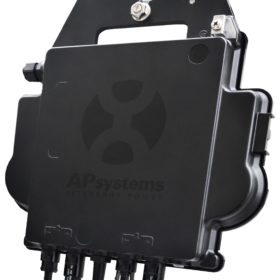
APsystems reveals dual microinverter
The 97%-efficient microinverter has a power output of up to 960 VA and APsystems claims it is the most powerful dual microinverter in the world.

Renewables vs. Nuclear: 256-0
The latest World Nuclear Industry Status Report shows that the world’s operational nuclear capacity grew by just 400 MW in 2020, with generation falling by 4%. By contrast, renewables grew by 256 GW and clean energy production rose by 13%. “Nuclear power is irrelevant in today’s electricity capacity market,” the report’s main author, Mycle Schneider, told pv magazine.
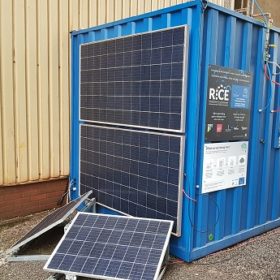
The Hydrogen Stream: Mongolia’s potential for producing green hydrogen at $3.30/kg
A German research group has identified Mongolia’s South Gobi region as an ideal location for the production of cost-competitive green hydrogen. Elsewhere, the U.K. is seeing more on and offshore-powered renewable hydrogen projects.
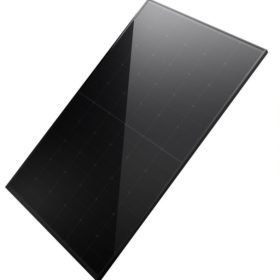
Longi announces 400 W solar panel with 22.2% efficiency
Conceived for rooftop applications, the module is also available in a full-black version with a power output of 390 W. It features a temperature coefficient is -0.29% per degree Celsius.
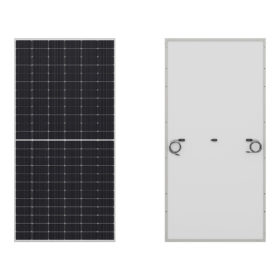
Sharp launches 540 W half-cut PV module with 20.9% efficiency
The IEC/EN61215 and IEC/EN61730-certified panel features 144 half-cells based on M10 wafers and a 10-busbar design. Its operating temperature coefficient is -0.341% per degree Celsius and its power tolerance reaches up to 5%.
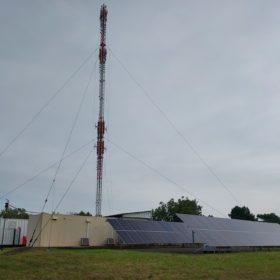
Solar-plus-hydrogen for air traffic control
A 19.8 kW PV system is powering a telecommunications antenna at a French air control center. When it produces more energy than needed, the surplus is used to produce hydrogen which is then utilized to produce new electricity via a fuel cell system and provide power to the antenna during a period of up to five days. For short-term storage, lithium-ion batteries are used.
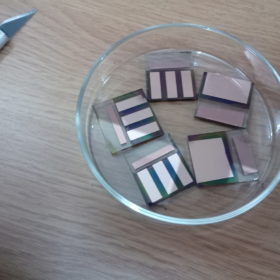
Large area perovskite solar cell with copper metal contact
An Indian research group has built a perovskite cell that has a metal contact based on copper, instead of expensive gold. The device showed almost the same efficiency as a cell developed with gold metallization but its stability was much lower. In order to overcome this issue, the scientists suggest using a metal contact made of a thin layer of gold and a thicker, overlying copper layer.

Adani, Reliance to set up solar gigafabs in India
Adani, Reliance New Energy, Jindal India Solar and Shirdi Sai Electricals have been put on a shortlist for India’s production-linked incentive scheme for high-efficiency PV module manufacturing. The list includes 14 other companies vying for the incentives.

Tesla’s storage facility comes online at Mohammed bin Rashid solar park in Dubai
The 1.21 MW/8.61 MWh storage facility is the second battery deployed at the 5 GW solar park. The system allows bi-directional charging.
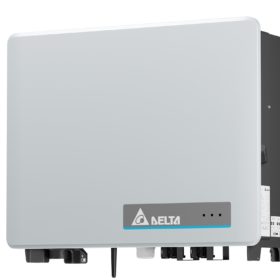
Delta expands string inverter series with two new products
The two three-phase inverters feature two maximum power point trackers and have input voltages ranging between 200 and 1,000 V DC. The smallest device has an efficiency of 98.3% and the largest 98.5%.
