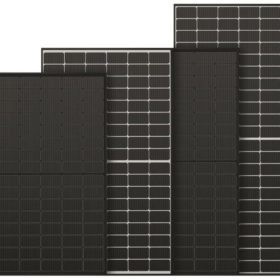
Sonnenstromfabrik launches new PV module series with large wafers and power of up to 490 W
The German solar manufacturer has unveiled three new formats for its glass-film and glass-glass PV modules for the first quarter of 2022.
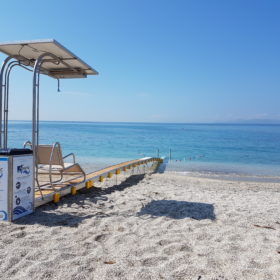
PV-powered autonomous sea access for people with disabilities
Greek startup Tobea has developed a PV-powered platform for people with disabilities. The system consists of a fixed-track mechanism in which a moving chair can be shifted in and out of the water. It can be powered by conventional modules and relies on a battery supplied by a Greek manufacturer.
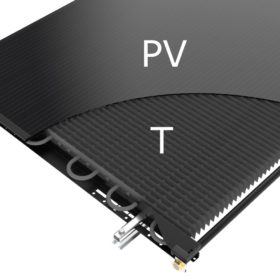
Triple Solar unveils new photovoltaic thermal panel for heat-pump houses
Dutch company Triple Solar has launched a new PVT module for residential applications which can be connected to water-to-water or PVT heat pumps. The new panel is said to be 10% larger and have a 15% higher output than the company’s other products and can reach a PV power output of 450 W.
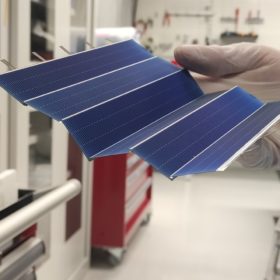
Fraunhofer ISE develops solder-free aluminum interconnection tech for shingled PV modules
The German research institute has unveiled a novel interconnection technology for shingled PV modules that eliminates the need for electrically conductive adhesives and screen-printed busbars. It consists of an 8-μm-thick aluminum foil that is joined to the silicon nitride (SiNX) passivation via laser metal bond (LMB). When integrated in a solar module, the efficiency of the new interconnector improved by 0.7%.

How long do residential storage batteries last?
Multiple factors can affect the lifespan of a residential battery energy storage system. We examine the life of batteries in Part 3 of our series.
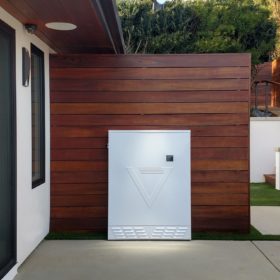
Residential battery inverter from the US
US storage system provider NeoVolta has developed a battery inverter that provides 32 A of AC output power. It has a storage capacity of 14.4 KWh that can be expanded to 24.0 kWh with the addition of another battery without the need for a second inverter.

Agrivoltaics for strip farming
Vattenfall is leading a Dutch consortium in a research project to assess whether agrivoltaics is also compatible with strip cropping. The company’s head of Solar Development NL, Annemarie Schouten, spoke with pv magazine about the first 0.7 MW pilot project under development in the northern Dutch province of Flevoland.

Lightyear solar car has raised more than $110m this year
The Dutch start-up behind the world’s first commercial grid-independent solar car has generated significant investment this year. Deliveries of the prototype Lightyear One are now set for next summer.
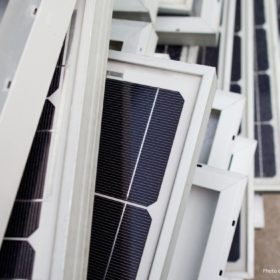
Recycling solar panels: Making the numbers work
NREL researchers said a profitable and sustainable solar panel recycling industry could establish itself by 2032. Here’s how the numbers work.
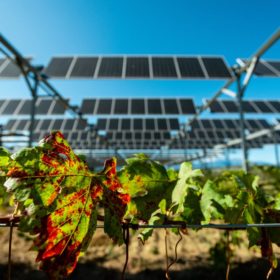
Agrivoltaics for viticulture
French specialist Sun’Agri installed a pilot facility on five hectares in southern France in 2018. Its goal is to protect the vines from weather hazards and to improve the quality of the wine by lowering its alcohol content. The first harvest took place in mid-September.
