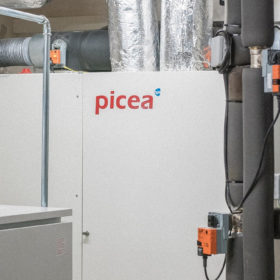
Hydrogen-based storage system for residential applications
The system is based on a power-to-gas hydrogen technology and is intended to enable one and two-family homes to have an independent power supply throughout the year.

The Hydrogen Stream: US government wants to reduce green hydrogen cost by 80% to $1 per kilogram in one decade
Furthermore, Swiss energy company Axpo and Swedish-Swiss electrical equipment giant ABB committed to combining their technologies and skills for several projects related to green hydrogen in Italy and Germany’s gas transmission system operators Gascade and Ontras announced a plan to set up a platform for the hydrogen industry in eastern Germany, with an initial grid to cover 475 kilometers of pipelines.

‘Where appropriate, agrivoltaics can certainly be a viable and meaningful alternative to large-scale solar’
US expert in environmental and energy policy Alexis Pascaris spoke with pv magazine about opportunities and barriers associated with agrivoltaics. Agrivoltaics are a very practical and advantageous alternative to large-scale solar, specifically in places where there are land-use constraints or needs for rural economic development, she explains. Differences in costs related to ground-mounted solar can typically be attributed to the raised racking systems or additional fencing, but these upfront investments in specialized hardware are eventually recovered as agrivoltaic systems produce dual-revenue streams.

Investigating all-manganese flow batteries
Scientists in Germany fabricated an all-manganese flow battery, which they say serves as a proof of concept for the potential of such devices. Their results working with various battery configurations show that cheap, abundant manganese has plenty of potential for flow battery applications; and is worthy of further investigation in the frame of developing sustainable energy storage technologies.
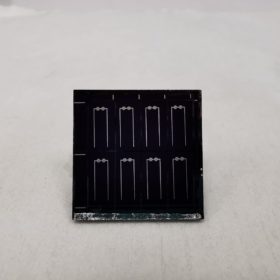
Pure sulfide CIGS solar cell with 15.2% efficiency
The device was built by an international research team. The cell features a buffer layer based on zinc sulfide oxide and a low copper absorber. The cell showed an open-circuit voltage of 920 mV. And though a different material from the widely commercialized CIG selenide PV thin films, the researchers claim similar processes could be used in its large-scale manufacturing.
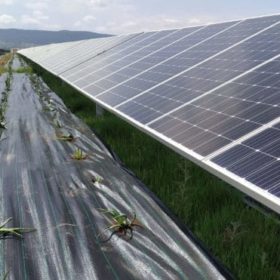
Australian solar park to host crops as part of agrisolar program
Italy’s Enel will launch an experimental agrivoltaics program at its 34 MW Cohuna Solar Farm in the Australian state of Victoria to help formulate a “best practices” template for utility-scale solar PV sites in other countries.
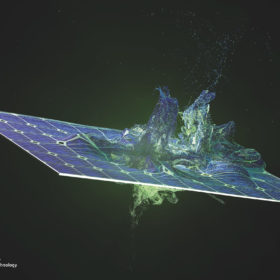
New process to recycle silicon, silver and glass from end-of-life PV panels
A €4.8 million EU-funded research project is aiming to develop a process that allows recovering all components of a photovoltaic module.

Building renovations crucial for heat pump deployment
Building renovations may result in up to 51% space heating demand savings, according to recent research from Germany. Its authors claim that, if buildings are retrofitted and thermal energy storage and individual hybrid heat pumps with back-up gas boilers are applied on a large scale, significant heat cost reduction may be achieved across the whole of Europe.
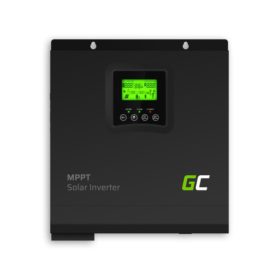
Green Cell unveils off-grid inverters for small residential buildings
Poland-based Green Cell is offering two versions of its new inverter, with power outputs of 1 kW and 3 kW. The inverters feature an efficiency of 90% and are recommended for small buildings such as cottages or year-round homes.
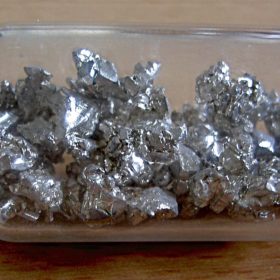
Cathode discovery ‘opens up new pathways’ for calcium-ion storage
Scientists in South Korea tested a new cathode material as part of a calcium-ion battery (CIB), achieving some impressive results. The material retained more than 90% of it initial capacity after 500 cycles, alongside some of the best performance results seen so far for this technology. The scientists say that this discovery opens up “an unexplored pathway toward the realization of stable and high-power cathodes in CIBs.”
