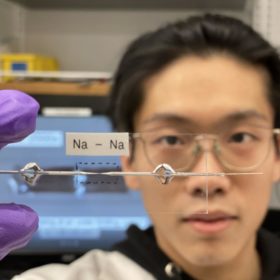
A stable sodium battery, without the anode
Scientists in the U.S. demonstrated a sodium-ion battery with no anode, that retained 99.93% of its initial capacity per cycle. Their design was able to overcome many of the stability issues associated with using ‘pure’ alkali metals in batteries, thanks to carefully minimizing water content in the liquid electrolyte.
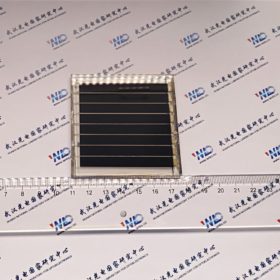
16.63%-efficient perovskite PV module via slot-die coating
Scientists in China have developed a large-area perovskite solar panel by utilizing diphenyl sulfoxide (DPSO) as an electron acceptor. The device was fabricated via slot-die coating, and featured a parallel-interconnection architecture.

A different angle on perovskite defects
Scientists in China took a closer look at the role of defects in limiting the performance of perovskite solar cells, demonstrating a screening effect that could be tuned to make material defects “invisible” to charge carriers, greatly improving cell performance. Using this approach they demonstrate a 22% efficient inverted perovskite solar cell, and theorize several new pathways to even higher performance.
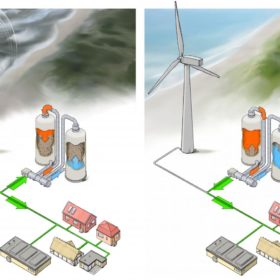
Storing large scale renewables with basalt stones
A Danish consortium is seeking to store electricity from large scale renewable energy plants in the form of thermal energy in big tanks containing crushed, pea-sized stones made of basalt. The first 10 MWh demonstrator is planned to be developed in Denmark and to be powered by a wind facility. Another project is also under development in the United States and is planned to be linked to a solar plant.
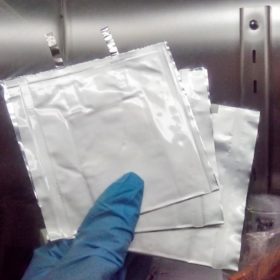
Lithium saturation to make old batteries new
Scientists investigating the aging mechanisms affecting today’s lithium-ion batteries observed that the loss of lithium over time is one of the main causes of performance loss. With this in mind, they developed and tested a “relithiation” process that promises to eliminate much of the cost and complexity from recycling battery components and materials.

Solar sculpture to produce 300 MWh of electricity annually
Called Solar Mountain, the permanent installation should be built in Nevada with modular design elements of recycled wood and other environmentally friendly materials.
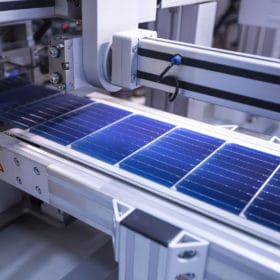
Longi sets TOPCon cell record of 25.09%
The world’s number one solar manufacturer said the result has been confirmed by the Institute for Solar Energy Research in Hamelin, Germany.
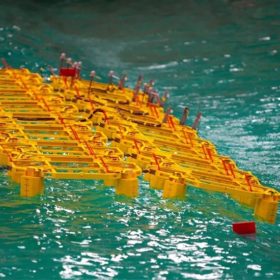
Floating structure design for offshore PV
Researchers at the Norwegian institute Sintef are testing a special floating structure that Equinor wants to deploy in offshore waters. The structure is built with an anchoring system that is claimed to give the installation enough freedom to cope with the waves.
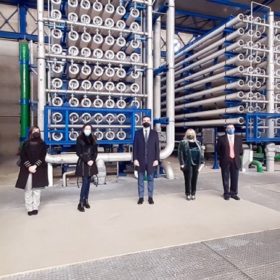
Solar revitalizes abandoned desalination plant in Spain
A new €99 million solar project will help the Rambla Morales desalination plant, which shut down in 2011, to resume operations by fall 2022.

Absorbent glass mat battery for residential storage
Silicon Valley-based start-up Gridtential has secured $12 million in funds to develop what it calls the world’s first factory-ready, single-block, 24V, deep-cycle lead battery. The product is claimed to be ideal for personal mobility vehicles and renewable energy storage in homes and offices.
