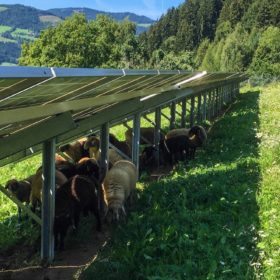
Solar projects enable biodiversity
Eco-Tec, an Austrian PV company, is cooperating with a startup, Meine Blumenwiese, to ecologically upgrade ground-mounted solar projects. The two companies aim to generate clean energy while also creating new habitats for a range of insects and animals.

Computational method shows Italy may install 144.5 GW of PV by 2050
According to a new study, PV may reach an installed power of 144.5 GW in Italy by the end of the first half of the century, followed by onshore and offshore wind with 59.6 GW and 17.6 GW, respectively. The research is based on a new computational model that identifies the best spatial distribution of renewable energy sources in an individual country or electricity system while avoiding problematic concentrations of technologies
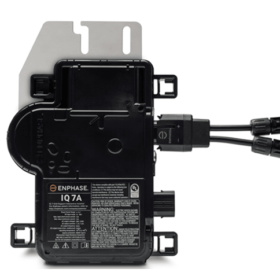
Enphase microinverters for high-power modules
The US microinverter manufacturer has now brought its inverter solution for commercial and industrial solar to Australia and Europe. The device is suitable for modules with power output ranging from 295 to 450 W and has a European efficiency of 96.5%.
New dopants may improve PV glass performance
According to a British-Swedish research team, the down‐shifting process for solar glass manufacturing can be improved through the use of two dopant cations that produce no absorption bands. The doping with these compounds is said to reduce the UV transmission while also keeping the glass free from absorption in the visible and near-infrared ranges.
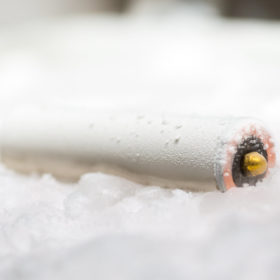
Lithium metal enabler for low temperature batteries
Scientists in the United States demonstrated a new route to improving battery performance. The group integrated a self-assembling layer which forms on the surface of the anode, preventing the formation of dendrites. While their prototype has a very short lifetime, the group is convinced approach could lead to better performing batteries, and is particularly promising for low temperature applications.
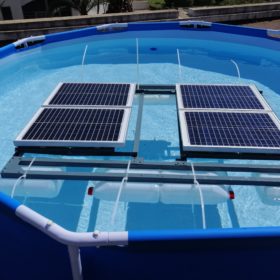
Test bench compares floating PV with onshore solar arrays
Moroccan researchers have set up a new floating PV test bench. They claim floating solar arrays offer better power yields than rooftop and ground-mounted PV systems, with lower module operating temperatures.
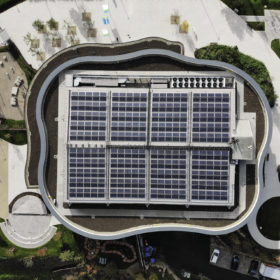
The weekend read: Hydrogen and the energy transition
Researchers are now simulating how the energy transition can be as successful and cost-effective as possible. As part of the simulation, they are also calculating how much hydrogen will be needed and where it could come from. In Germany, a recent study by Fraunhofer ISE showed that the cost is so low that the nation could gift itself the energy transition as a Christmas present.
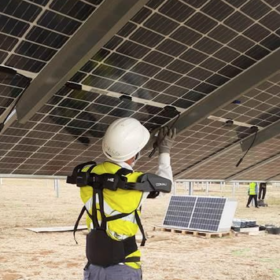
Exoskeletons for solar panel mounting
Endesa, the Spanish unit of Italian power group Enel, is using a new technology in the construction of three solar parks in southern Spain.
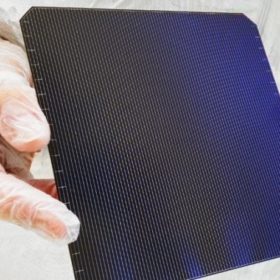
Enel and French PV institute achieved an efficiency of 25.0% for a heterojunction solar cell
The solar cell calibration laboratory ISFH CalTeC has certified the efficiency of the cell, which was made with a standard M2 wafer.

‘Bigger is not always better’
Chinese monocrystalline PV module manufacturer Longi has yet to join the race to produce solar panels with power outputs above 600 W. The decision is line with a clear strategy, a company spokesperson told pv magazine. Outstanding issues for these moduels, according to the manufacturer, include low cell manufacturing yield, system compatibility, concerns about module transport, and hotspot-related failure risks, as well as the need for mechanical loading tests.
