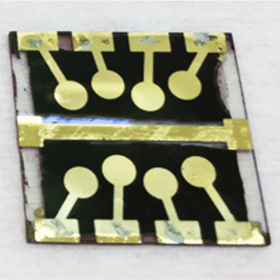
Water-splitting tech to reduce moisture in perovskite solar cells
Italian researchers have engineered a hole extraction layer with water-splitting additives to reduce the impact of moisture in perovskite PV devices. They claim that the method ensured a power conversion efficiency of more than 9% in perovskite cells stored for a month in a water-saturated atmosphere.
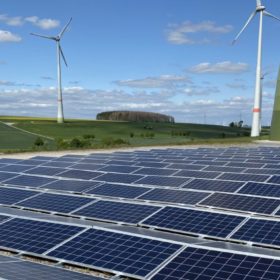
New mounting system to integrate small PV into wind farms
Switzerland’s Smartvolt has developed a special mounting system that facilitates the quick deployment of small ground-mounted PV systems at the base of wind turbines.

Hard carbon for a high energy sodium battery
Scientists in Japan demonstrated a hard-carbon electrode that can greatly increase the capacity of a sodium-ion battery. With further work on the long-term performance, the discovery could make sodium-ion batteries better able to compete on energy density with their lithium-ion counterparts.
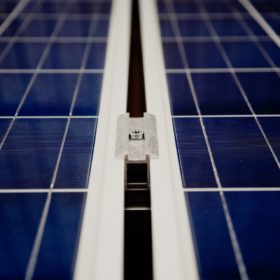
‘There is no clear best module configuration under partial shading’
A Slovenian research team has analyzed the behavior of a full-size cell PV module and several 1/6 cell panels under partial shading and has come to the obvious conclusion that the cell cut panels suffer fewer energy losses. They also found, however, that the orientation of the cells connected in series should be aligned as much as possible with the shade shape to lower the losses and to minimize reverse cell voltage.
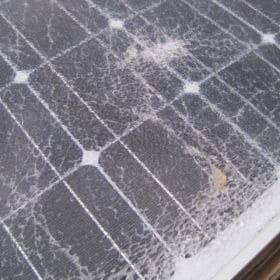
Urban land, aerosols could accelerate hail storm formation
Researchers from the U.S. Department of Energy have shown that urban landscapes and man-made aerosols have the potential to accelerate the formation of hail storms – a clear threat for PV arrays.
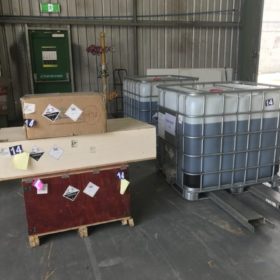
Australian Vanadium pushes ahead with plans for residential flow battery
Australian Vanadium is pushing ahead with plans to develop a vanadium redox flow battery for the Australian residential market, via its VSUN Energy subsidiary.
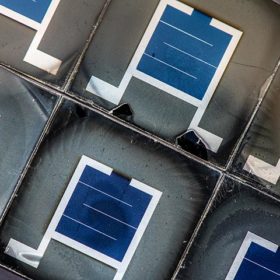
The state of the art in perovskite tandems
A new paper from scientists in China and Canada examines the recent progress in the development of perovskite-silicon tandem cells, finding a technology that’s poised for rapid commercialization, with a few research challenges still to overcome. These are primarily related to ensuring the perovskite layer can match the lifetime of the silicon cell underneath.
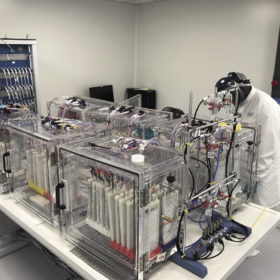
Sweden issues €5m call for battery studies
Researchers have just under four weeks to apply for backing for their projects, in areas including battery reuse and recycling, circular manufacturing and supercapacitors.
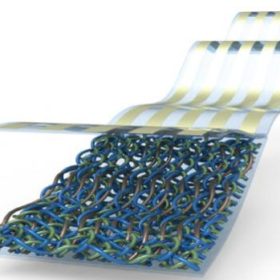
Herbicide may improve organic cell efficiency by up to 1.6%
Researchers in Saudi Arabia claim to have increased the efficiency of organic PV devices with diquat, a compound used in herbicide. The molecular diquat dopant increased optical absorption and the lifetime of electrical charges when light was absorbed.

Indian reliance on polycrystalline tech production leaves it trailing China
Polycrystalline PV technology, which is seeing its market share tumble on the global stage, still dominates India’s small solar manufacturing base and is emblematic of the R&D shortfalls in the sector, according to a survey of the state of the industry.
