
Self-cleaning tech for small off-grid PV arrays
A U.S.-Pakistan research group has created a new self-cleaning mechanism for standalone PV systems up to 5 kW in size. The system increases power yields by around 35%, while its payback period is estimated at around five years.
Water-based cooling technique for photovoltaic-thermal systems
The novel technique consists of a PVC pipe with 20 holes that is placed on the top of a PV module and is able to maintain a constant discharge of water. It was demonstrated on an experimental photovoltaic-thermal PV system in which the PV panel was not integrated with the solar collector but connected to it via pipes.
The unstoppable trajectory of photovoltaic water pumps
Scientists in Russia have analyzed the most important technological advances achieved for solar water pumps over the past decades and have indicated the roadmap that future research should follow to expand their use and application.
Large-scale printing for perovskites
Scientists in Germany investigated printing processes for perovskite solar cells, making some important conclusions for the development of inks suitable for the deposition of perovskite cell materials onto a substrate.

Rooftop PV vs. rooftop farming
U.K. researchers have developed a way to optimize urban rooftop use with solar PV and agriculture.
A new catalyst for lithium-air batteries
Scientists in the United States demonstrated a lithium-air battery with improved energy and stability performance, thanks to the use of molybdenum triphosphide as a catalyst for both charge and discharge reactions.
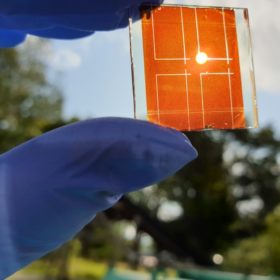
India and Israel to work together on perovskite solar cells and lithium sulfur batteries
Low-cost batteries and novel perovskite materials are among the topics selected for joint research and development.

Large-scale PV plant planning for weak power grids
Researchers in New Zealand have developed a new methodology for solar park planning that considers clear-sky radiation for voltage stability analysis. It is based on two different generation profiles for separate purposes.
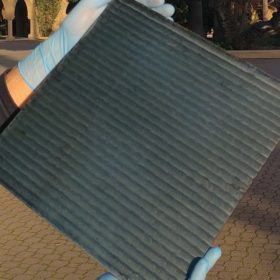
New manufacturing process for 15.5% efficient perovskite solar panels
Stanford scientists have used a robotic device with two nozzles to quickly produce thin films of perovskite. With these films, they have manufactured perovskite cells and modules with efficiencies of 18% and 15.5%, respectively. According to them, this technique may enable the production of perovskite modules at a cost of around $0.25 per square foot.

The future of cars is electric – but how soon is this future?
According to a new report by BloombergNEF, 58% of global passenger vehicle sales in 2040 will come from electric vehicles, yet they will make up less than 33% of all cars on the road.
