The weekend read: A responsible compromise?
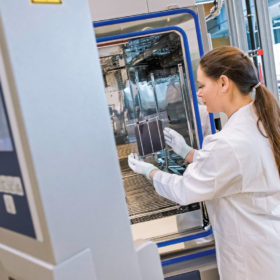
Toxicologists are struggling to follow the pace at which perovskite solar cells race from laboratory test benches to factory production lines. While researchers continue to assess the health and safety risks stemming from the lead used at the core of these new materials, the startups commercializing them argue that established encapsulation techniques and sound recycling schemes are enough to safety-proof their potentially disruptive technology and offset broader environmental threats.
International research group claims 8.8% efficiency for amorphous solar cell
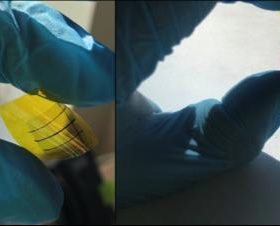
The new cell is based on a p-type transparent conductor made of carbon nanotube fibers. The device is said to offer 16% more efficiency than rival amorphous cells.
A new converter topology for hybrid wind-solar
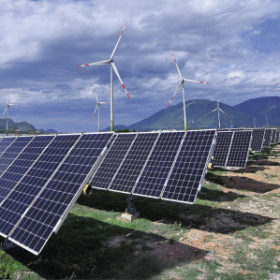
A researcher has proposed a new approach to apply maximum power point tracking techniques to optimize electricity production in wind-solar power projects. The permanent magnetic synchronous generator hybrid model used in the study is based on a multi-input rectifier stage which is said to be able to eradicate current harmonics and eliminate the need for extra input filters.

Organic dopants for a stable perovskite
Researchers at Saudi Arabia’s King Abdullah University of Science and Technology have demonstrated a method they say could improve the stability of perovskite structures. The group found adding an organic dopant served to increase the strength of chemical bonds between organic and inorganic elements of a perovskite.

Three steps to fast-charging potassium batteries
Scientists led by Moscow’s Skolkovo Institute of Technology have drawn upon several of their recent battery material innovations to create a potassium-ion device. The institute says its development will pave the way for ultrafast and durable, high capacity metal-ion batteries, to supply rising demand for energy storage innovations.

The problem with iron solar cells…
Researchers at Sweden’s Lund University have discovered a mechanism by which iron-based solar cells lose up to 30% of their charge. Understanding how the loss occurs, say the researchers, will be the first step to closing the loophole and developing more efficient solar cells based on the abundant material.
Germany sets new record for organic PV efficiency
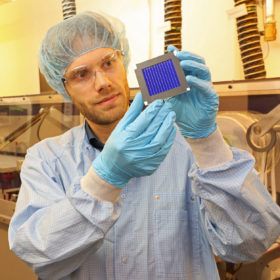
Scientists from several German research institutes, as well as South China University of Technology, have set a new efficiency record for an organic PV module. The group demonstrated a 12 cell, 26cm² module with an efficiency of 12.6%. The results have been confirmed by the Fraunhofer Institute for Solar Energy Systems.
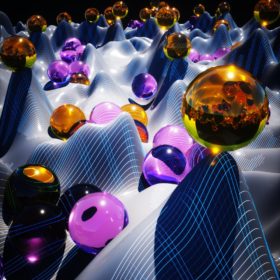
Orderly disorder: Cambridge scientists make surprising perovskite discovery
Researchers have made a finding they say could vastly simplify and reduce the production cost of perovskite solar cells. Working with mixed halide perovskites, the group found a disordered chemical composition can improve device efficiency.

Flixbus plans hydrogen buses on long-distance routes
Parent company FlixMobility plans to test hydrogen fuel cell vehicles in Europe.
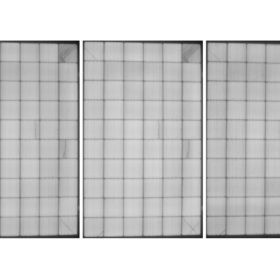
New metallization tech to reduce microcracks in solar cells
A U.S. research group has developed a metal-carbon-nanotube composite – MetZilla – which can be embedded in commercial, screen-printable silver pastes and is said to reduce the formation of hotspots in solar modules and to prolong panel lifespan. The composite metal contacts are also ‘self-healing’ as they are able to regain electrical continuity after cycles of complete electrical failure caused by extreme strain.
