
US research lab rewires solar cell efficiency to 27.3%, sees path to greater than 32%
NREL has published a paper showing an experimental solar cell, with a unique technique for wiring two separate solar cells into one, that increased the cell’s efficiency by 4%. The document also offers a respectable review of other technologies being developed.

Neural networks improving solar power forecasting
An international research team has developed a new approach for solar power forecasting that combines neural networks and pattern sequences for the first time. The performance of the new Pattern Sequence Neural Network (PSNN) was tested on an Australian data set that includes information from two years of forecasts. It can be used with different clustering and cluster-sequence extraction algorithms, and can be applied to multiple related time sequences

Another one fights the dust
Scientists from Israel have used nanowires to detach particles from the surfaces of solar panels. The proposed microscopic self-cleaning technology is said to raise the efficiency of particle removal with hydrophobicity.
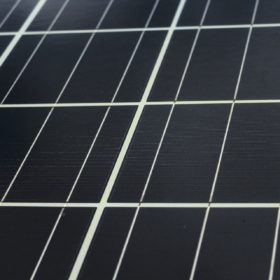
Liten research institute claims 24.25% efficiency for heterojunction cell
The French institute said the result has been certified by ISFH CalTeC, in Germany. The manufacturers claim they were able to increase cell performance by improving the plasma-enhanced chemical vapor deposition of amorphous silicon nanolayers and the conductive and anti-reflective transparent oxide layers.
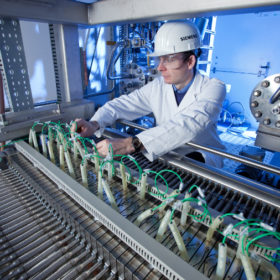
European Investment Bank signs hydrogen investment deal
The EIB and the Hydrogen Council aim to jointly develop new ways to generate funding for hydrogen projects under the European Commission’s InnovFin Advisory program. The two parties, however, have not disclosed the financial terms of their planned collaboration.

Europe approves €3.2bn to support battery R&D
The European Commission has approved use of funds given by seven member states to back Europe-wide R&D projects across the lithium-ion battery value chain, with the aim of potentially unlocking an additional €5 billion in private sector investment.
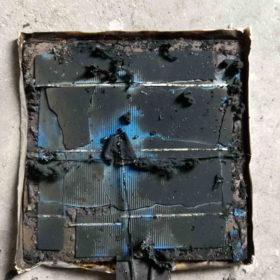
Scientists analyze toxic gases released from burning thin-film, PET-laminated modules
Scientists from China’s State Key Laboratory of Fire Science have analyzed the combustion behavior of flexible PET-laminated PV panels. They found toxic gases including sulfur dioxide, hydrogen fluoride, hydrogen cyanide and a small amount of volatile organic compounds are released when such a PV system burns.
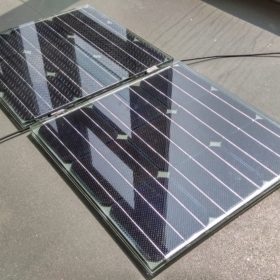
Walking on sunshine
Chinese scientists have developed a PV floor tile they say is suitable for pavements and cycling tracks. The devices were tested on a ‘green deck’ in Hong Kong. The developers say the tiles have demonstrated satisfactory solar energy conversion, anti-slip performance, heat-resistance and strength.
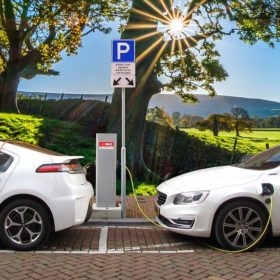
Australia lacks interest in EVs, global study finds
A global study has found that Australia lacks interest in electric vehicles, due largely to the impedimental admixture of cost, range anxiety, and a lack of charging options.
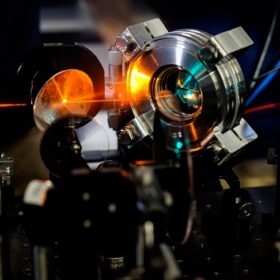
Hot charge extraction to push perovskite efficiency
With the absorption of ‘hot’ charges, which lose their energy faster than it can be absorbed by any convention technology, solar cells could become massively more efficient. An international group of scientists has developed a method to examine the bond between a perovskite and charge extraction layer, and determine the most suitable materials for hot charge extraction in a solar cell.
