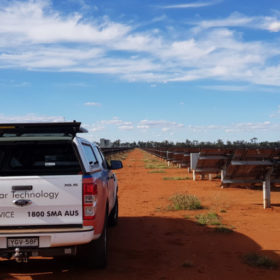
Price pressure and delivery bottlenecks lead SMA to significant loss in 2018
The German inverter maker struggled after China’s announcement at the end of May drove down prices and markets around the world and left a clear mark on its figures. Both the commercial PV segment and the storage business fell short of expectations due to delivery bottlenecks.
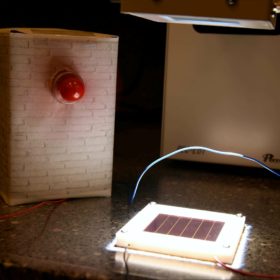
It’s all in the electrons – Japanese scientists give perovskites a push
Scientists at the Okinawa Institute of Science and Technology have developed a process for the creation of perovskite cells with better than 20% efficiency. The cells use a tin-oxide electron transport layer, which the scientists say can triple their operational lifetime.

Toyota and Panasonic to form EV battery joint venture
The deal foresees 3,500 employees from both companies joining the unit, as well as equipment and production facilities to be used to improve battery technologies and develop next-generation solutions.
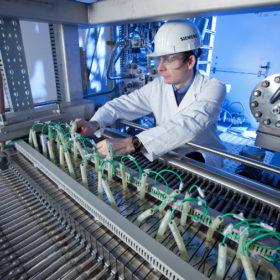
Australia may target green hydrogen exports in billion-dollar plan
The Australian Labor Party has released a National Hydrogen Plan, which involves directing AU$1 billion in CEFC funding towards clean hydrogen projects, $100 million in ARENA grants for hydrogen technology refuelling infrastructure, and $40 million from the CEFC’s Innovation Fund to help commercialise new hydrogen technologies and businesses. Looking towards clean energy exports, the plan will provide $3 million in funding to Queensland coal port in Gladstone with the aim of creating a hydrogen hub.
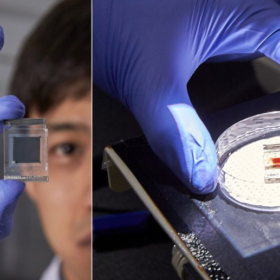
Korean scientists demonstrate new lead-free perovskite
A team of researchers from South Korea’s Ulsan National Institute of Science and Technology has demonstrated a new type of tin-based perovskite. The researchers say that, despite current low efficiency, levels could lead to improved understanding and the development of solar cells using lead-free perovskites.
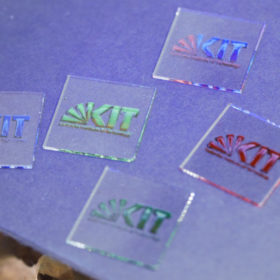
European researchers want to develop digitally printed, highly efficient and stable perovskite PV modules
German and Greek scientists are working with industrial partners on the technological feasibility of making solar modules based on perovskite absorbers. The prototypes should be freely configurable in size, shape and color.
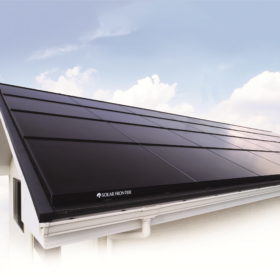
Solar Frontier hits new CIS cell efficiency record
The Japanese module maker has set a new record for CIS thin film cell efficiency. The company, with Japan’s New Energy and Industrial Technology Development Organization, achieved 23.35% conversion on a cell measuring 1 cm². The record was confirmed by the Japanese National Institute of Advanced Industrial Science and Technology.

The weekend read: Why are we not making the most out of big data analysis?
Although the solar industry sees itself as young, its assets are aging. Owners still struggle with the complexity of making the best use of big data analysis to improve plant efficiency and profitability. Ragna Schmidt-Haupt, of Everoze, examines why this has not changed, and what can or should be improved. Artificial intelligence, advanced data analytics, automated assessments and smart monitoring software – holistic solar asset management starts here.
11.7 MW of bifacial solar goes online in the Netherlands
The panels were provided by Chinese manufacturer Jolywood, which claims the Zonnepark Rilland project is the first utility-scale solar plant built with n-type bifacial modules in Europe.
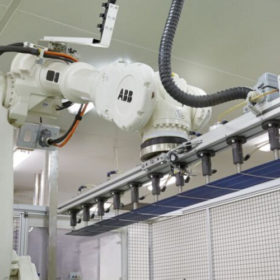
PERC cell efficiency records tumble
Chinese manufacturers Risen Energy and LONGi have both announced conversion efficiency records for PERC cells as the twin quest to drive down costs and increase energy output shows no sign of abating.
