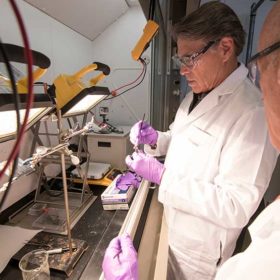
American scientists give PV a paint job
Berkeley researchers have discovered a shade of blue – dating back to ancient Egypt – which has impressive qualities they say could reduce building energy consumption and boost solar energy output. Meanwhile, the US National Renewable Energy Laboratory has developed a perovskite cell material that could be applied to a substrate using a paintbrush.
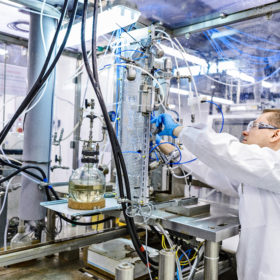
Innolith launches non-flammable battery with 50,000 charging cycles
Inorganic electrolytes will do the trick the company says. For multi-MW grid-scale applications the company says its technology can boost battery life to 50,000 cycles and is non-flammable. It adds that the costs of the product are competitive with conventional battery systems. Innolith is taking over the baton from Alevo, including chief executive and engineers. Alevo, however, went bankrupt last year, making the same promises.
TOPCon: The next big thing after PERC
TOPCon technologies could further increase solar cell efficiencies, said Guangyao Jin, chief scientist, DuPont Photovoltaic Solutions, at this year’s Energy Taiwan, held in September. He added that metallization paste is crucial.
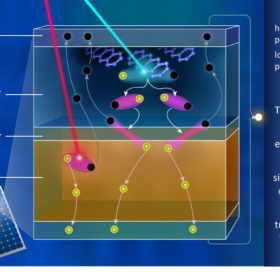
German scientists work on efficiency boosting cell concept
Researchers from Berlin’s Helmholtz Zentrum Research Institute have developed a silicon heterojunction cell, with an additional crystalline layer that utilizes an effect known as singlet fission to boost efficiency. The team has created a device demonstrating that the principle works, and says that with further experimentation, the concept could achieve cell efficiencies as high as 40%.
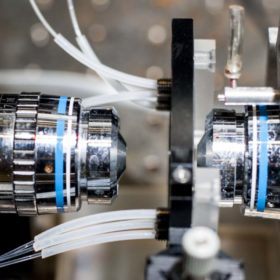
“Optical Tweezers can benefit solar cell research” – Interview
pv magazine interviewed Ricardo Arias González, who holds a PhD in Physical Sciences and introduced the Optical Tweezers applied to biology in Spain. It is one of the tools of photonics for which Arthur Ashkin received the Nobel Prize in Physics in 2018, together with Donna Strickland and Gérard Mourou.
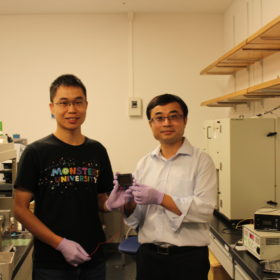
Japanese scientists develop new perovskite process
A team of researchers from the Okinawa Institute of Science and Technology (OIST) has developed a new process for the production of perovskite solar devices; and reports a 5x5cm² device with an efficiency above 15%. The researchers worked with a 1 micron thick active layer, considerably thicker than in many other perovskite devices, and state that this helped achieve better long-term stability.

EU PVSEC: “Multicrystalline silicon will not die”
At first glance, the European PV conference this week has confirmed the widespread view that the upswing of monocrystalline technology will accelerate. But a closer look reveals that multicrystalline solar cells are still in the game.
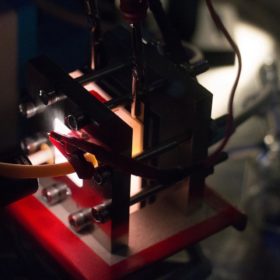
International research group develops solar cell with storage properties
Although the “solar flow battery” is currently considered too expensive by its own creators, a further improvement of its design and the use of emerging solar materials and new electrochemistry may open new opportunities for this kind of technology.
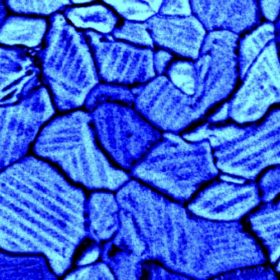
Scientists show hybrid organic–inorganic perovskite is ferroelastic, not ferroelectric
This means that this promising material, contrary to common belief, is able to form domains of polarized strain to minimize elastic energy. The research team made its discovery by using multimodal imaging.
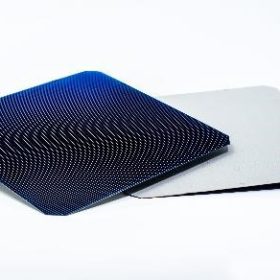
New records and results abound at EU PVSEC
The EU PVSEC conference, held this week in Brussels, was filled with bold announcements regarding solar’s trajectory in the coming years; and is backed up by a few announcements of new world records and impressive results from industry players and leading research institutes.
