
EU PVSEC: “Multicrystalline silicon will not die”
At first glance, the European PV conference this week has confirmed the widespread view that the upswing of monocrystalline technology will accelerate. But a closer look reveals that multicrystalline solar cells are still in the game.
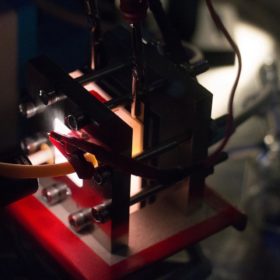
International research group develops solar cell with storage properties
Although the “solar flow battery” is currently considered too expensive by its own creators, a further improvement of its design and the use of emerging solar materials and new electrochemistry may open new opportunities for this kind of technology.
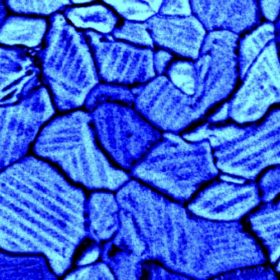
Scientists show hybrid organic–inorganic perovskite is ferroelastic, not ferroelectric
This means that this promising material, contrary to common belief, is able to form domains of polarized strain to minimize elastic energy. The research team made its discovery by using multimodal imaging.
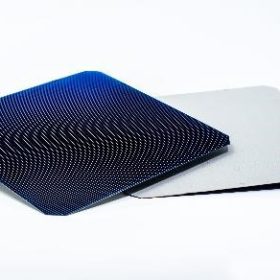
New records and results abound at EU PVSEC
The EU PVSEC conference, held this week in Brussels, was filled with bold announcements regarding solar’s trajectory in the coming years; and is backed up by a few announcements of new world records and impressive results from industry players and leading research institutes.
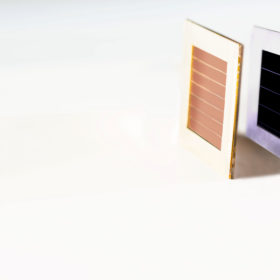
Imec claims 24.6% efficiency for tandem CIGS cell based on perovskite
The Belgian research institute developed its cell in partnership with EnergyVille, Solliance and German research center, ZSW.
Oxford PV, Oxford University target 37% efficient perovskite solar cells
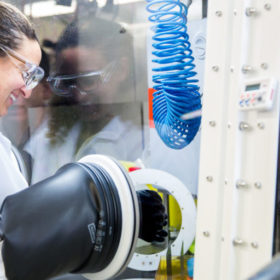
The solar company has launched a five-year research project with the British scientists, which has been funded with £2.5 million from the U.K. Government. The goal is to develop a thin film multi-junction perovskite solar cell with a 37% efficiency and long-term stability.
Netherlands to test viability of solar roads
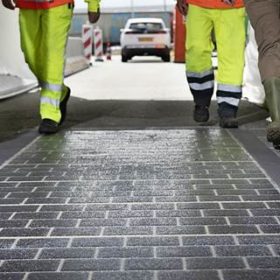
Although solar energy roads are still considered economically unviable, the Dutch water management agency, Rijkswaterstaat announced it will investigate their potential as an alternative to the lack of surfaces for PV deployment in the Netherlands.
pv magazine Quality Roundtable, Taiwan: Carrier-induced solar cell degradation: Solved (sort of)
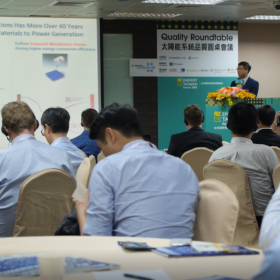
Solar cell manufacturers are always on an R&D race to improve efficiency. But even with their efforts, today you can still expect up to about a 3.5% loss from carrier- or light-induced degradation, industry insiders claimed last Thursday at pv magazine’s Quality Roundtable, held at Energy Taiwan 2018 in Taipei.

Better bifacial adoption, catalyzing innovation focus of Future PV Roundtable at REI
pv magazine’s Future PV Roundtable, held at the 2018 Renewable Energy India (REI) Expo in Greater Noida, discussed how India can better adopt bifacial solar cell and module technology – the future of power generation. Prominent industry speakers also put forth their views on how standards can catalyze solar innovation for India-specific challenges, and on PV materials and components for enhanced module efficiency and recycling.
Canadian Solar unveils new 400+ Watt bifacial poly PERC black silicon module
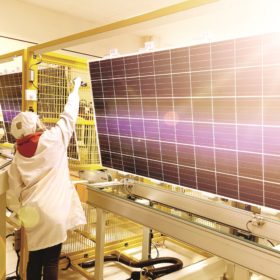
The Chinese-Canadian module manufacturer says its P4-based BiHiKu panel, for large commercial and utility-scale solar projects, is able to provide up to 30 per cent additional output from the rear side.
