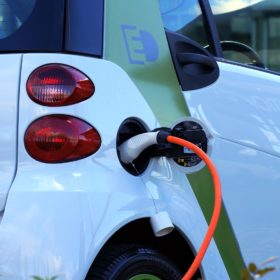
Dutch government treats 21 municipalities to smart EV chargers
Vehicle-to-grid functions could soon become increasingly important. While policymakers discuss the necessary regulations in other nations, the Netherlands government is motoring ahead with the technology.
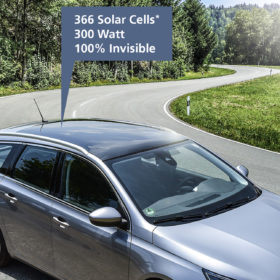
Fraunhofer ISE displays colored solar car roof at auto trade fair
An increasing number of carmakers and research institutes are developing concepts that combine e-mobility and solar. Thus far, range additions from in-car panels of between 10 and 60km are the limit of innovation. The Fraunhofer roof is tinted with a color that hides the cells but lets through most of the light.
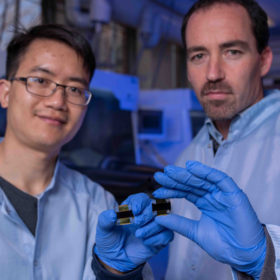
Australia National University hits new perovskite efficiency record
Scientists at the institution have achieved 21.6% efficiency with a perovskite cell measuring 1cm². The landmark has been verified as a new world record for perovskites at this size.

Rajasthan eyes 50 GW of solar within six years
The Indian state plans to achieve half the amount by 2021-22 under its new draft solar policy. The package also suggests establishing a research hub, privately financed solar parks and encouraging commercial self-consumption of clean energy.
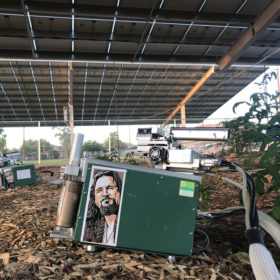
Food crops do better in the shade of solar panels
Another study has highlighted the advantages of combining solar with agriculture. According to the paper, growing chiltepin pepper, jalapeno and cherry tomato in dryland areas of the U.S. under the shade of PV modules is not only possible, but can lead to a better harvest.
Coating could lead to commercial lithium-metal batteries

A new coating developed by scientists at Stanford promises to bring lithium metal batteries ‘closer to reality’, by significantly extending their operational lifetime and limiting the occurrence of dendrites at the anode, which can cause short circuiting and fires.

Canadian researchers have done the math on optimizing PV output
Mathematicians at Canada’s University of Waterloo who turned their attention to solar power have developed an algorithm they say offers better control over PV plant output. The researchers estimate the algorithm could improve the output of a 100 MW power plant by almost a million kilowatt-hours per year.
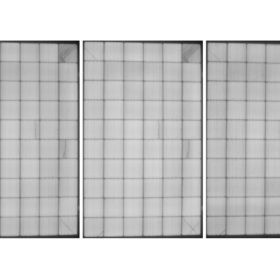
Tuesday webinar: New test for microcracks will ‘push the industry to exceed benchmarks’
A new test design from the University of Central Florida has challenged modules with different cell technologies. The results show advantages for the heterojunction modules tested. Here we discuss the new method with its designer.

Mini series: Creating a common language for solar in the energy mix
As solar comes to represent a larger proportion of the global energy mix, direct comparisons with conventional energy sources, and even with other renewables, are becoming more and more important. This is reflected in a bid by the United Nations Economic Commission for Europe’s (UNECE) Expert Group to standardize reporting on solar energy potential. Long Seng To, Royal Academy of Engineering research fellow at Loughborough University, and part of the UNECE solar energy subgroup, discusses the draft standards.
Mini series: The evolution of testing
Tara Doyle started her career in the solar energy industry more than 15 years ago, and today serves as the chief commercial officer at PVEL, which claims to be one of the first testing laboratories to focus on bankability for the downstream PV buyer community. The lab serves developers, financiers, O&M companies, asset owners, and insurers.
