
Sharp hits 25.09% efficiency on full size HJT cell
Japanese electronics giant, Sharp has announced the achievement of a 25.09% conversion efficiency, from a cell utilizing both heterojunction (HJT) and back contact technology. The measurement has been validated by Japan Electrical Safety & Environment Technology Laboratories (JET).

French energy giants keep investing in renewables
Engie has become partner of the solar and hydrogen-propelled catamaran, Energy Observer, while Total has become the founding partner of the Cathay Smart Energy Fund in China.

SERIS researchers develop new multi-cSi texturing technique
Scientists from the Solar Energy Research Institute of Singapore (SERIS) have announced the development of a new wet chemical process to allow multi-cSi wafers to be cut with diamond wire saw technology, and subsequently textured to reduce their reflectivity.
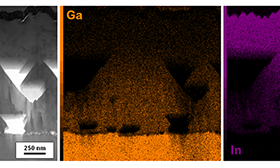
Luxembourg scientists provide new insight on how sodium can be used in thin film solar cell manufacturing
The research team found that sodium, contrary to common belief, does not decrease per se indium and gallium interdiffusion, but instead hinders intergrain diffusion by segregating at grain boundaries.

Solliance hits 26.3% efficiency on perovskite/silicon tandem solar cell
European solar research organization, Solliance and the Energy Research Center of the Netherlands (ECN) have announced the achievement of 26.3% efficiency on a transparent perovskite solar cell combined with a crystalline silicon solar cell.

Fixing perovskite defects with potassium
Scientists led by Cambridge University have discovered that adding a simple solution of potassium to the ink solution has the effect of ‘healing’ defects in metal-halide perovskite films, and immobilizing ion movement. This, according to the researchers, could push the material to higher efficiencies, while also increasing stability.

US scientists gain new insight into inner workings of hybrid perovskites
Researchers at Stanford University and the Department of Energy’s SLAC National Accelerator Laboratory have provided a new understanding of what happens inside a hybrid perovskite material in the first few trillionths of a second after it is hit with simulated sunlight.
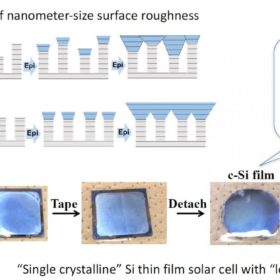
Japanese scientists develop ZHR method to improve manufacturing of thin film monocrystalline silicon
The research team believes that the new technology may resolve technical problems and drastically reduce the manufacturing cost of the lift-off process in the production of thin film monocrystalline solar cells.
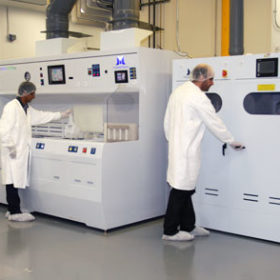
Natcore develops new processes for patented foil cell
U.S. based technology company, Natcore has announced two new processes, which it says could dramatically reduce the production costs of its foil cell, which it has been working to commercialize for the past couple of years.

Q&A: JinkoSolar discusses half cut cells, multi-busbars and bifacial technology
Ahead of its upcoming webinar, on March 27, JinkoSolar’s Head of Technical Service Europe, Andrea Viaro, discusses the company’s new Half Cell (HC) Series, the benefits of multi-busbar and bifacial technology, and upcoming innovations, in a Q&A with pv magazine.
